Stanley Penguins: Where To See Them And What To Expect
Stanley, on Tasmania's north-west coast, is one of the few penguin towns with no tour at all: viewing is free, self-guided and governed by the same quiet, red-light rules that apply everywhere else in the state.
Short answer
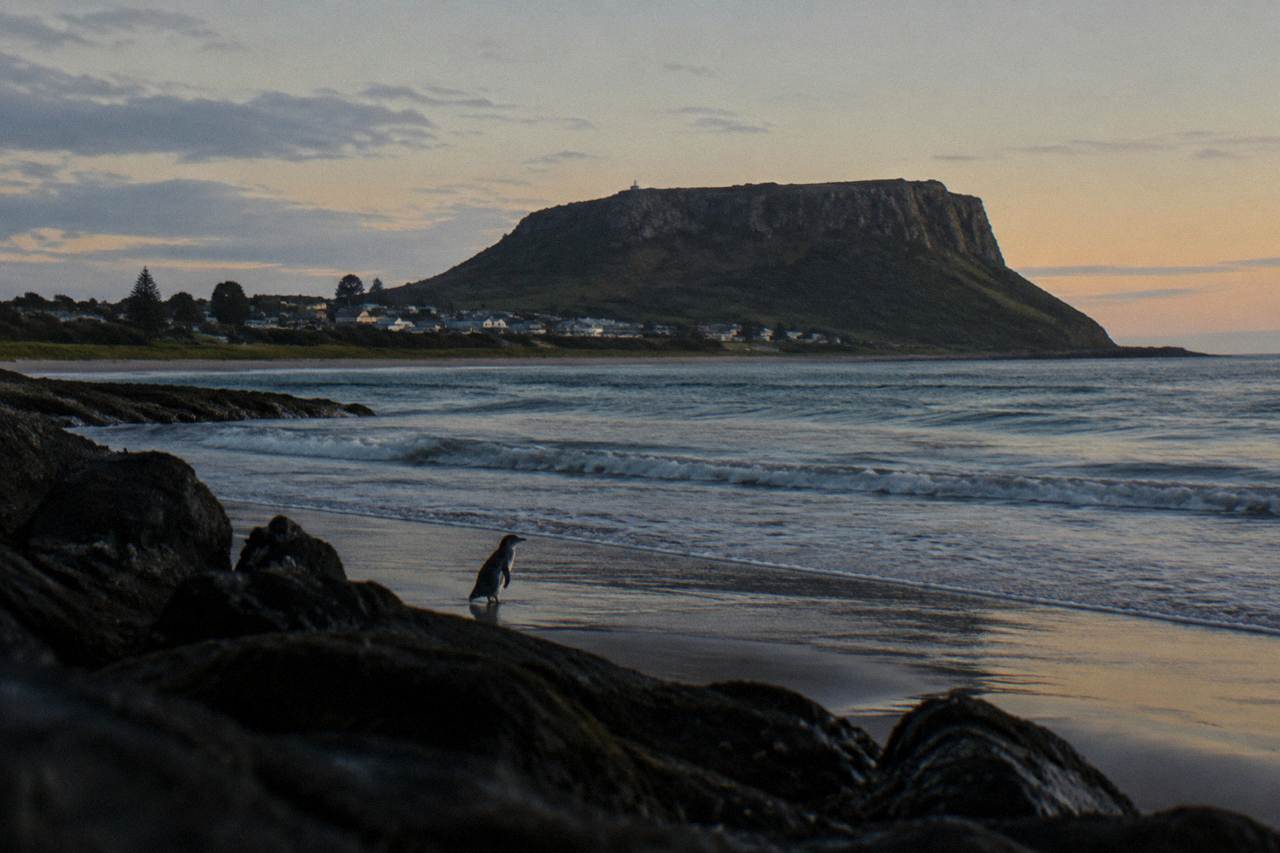
Stanley has no guided penguin tour. Viewing is free and self-guided, reported at the Godfreys Beach platform with red lighting and level access, with Tatlows Beach as a second spot, best from September to March at dusk. The nearest guided tour sold on this site is the Low Head tour from $83 per person, rated 5.0 from 22 reviews.
Stanley sits under the Nut, a flat-topped volcanic plug that dominates the north-west coast, and its evenings belong to little penguins. The town is unusual in Tasmania's penguin country: there is no tour operator, no ticket desk and no guide with a red torch. Everything here is do-it-yourself, free, and dependent on you following the state's penguin watching rules. This guide sets out where to stand, when to go, what the rules are, and how a night at Stanley compares with the guided tours at Low Head and Bicheno for travellers who want more certainty.
Where Can You See Penguins In Stanley?
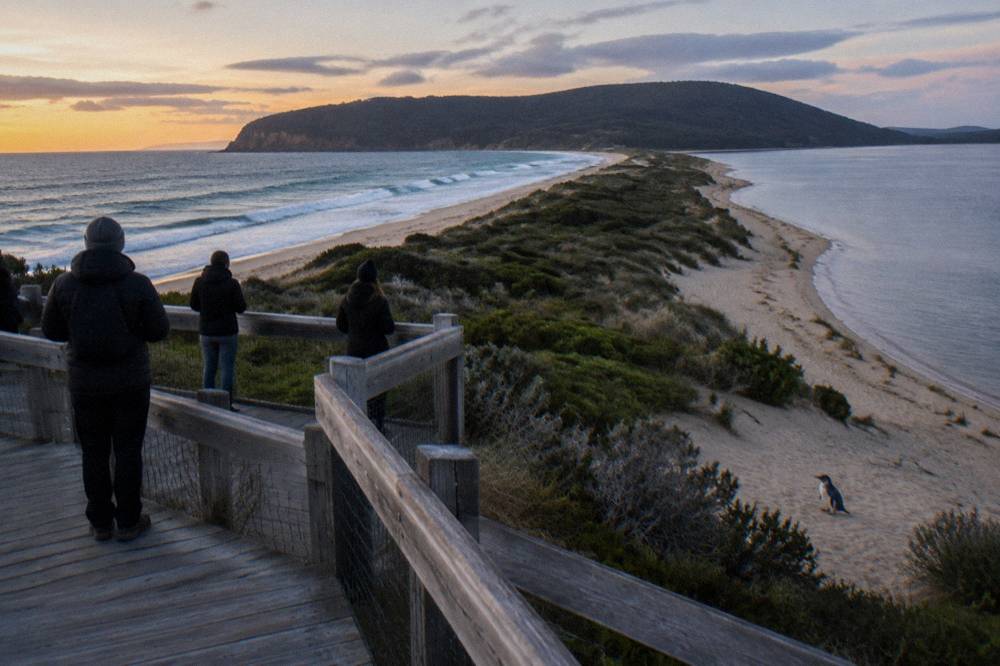
Stanley's penguin viewing is free and self-guided: the Godfreys Beach viewing platform west of town is the main spot, reported to have red lighting and pram and wheelchair access, with Tatlows Beach as a second option. No guided penguin tour operates in Stanley, and birds come ashore at dusk, best from September to March.
The Parks and Wildlife Service names the Nut State Reserve among the places where little penguins and shearwaters can be seen at dusk, alongside better-known sites like Bruny Island Neck and Low Head Lighthouse. In practice, the reported viewing infrastructure at Stanley is modest: a platform at Godfreys Beach, a short stretch of coast that penguins cross at night on their way to burrows in the dunes and adjoining reserve land. Since the penguins only appear after dark, many visitors spend the earlier evening exploring the Nut at Stanley before dusk, which sits just above the same stretch of coastline.
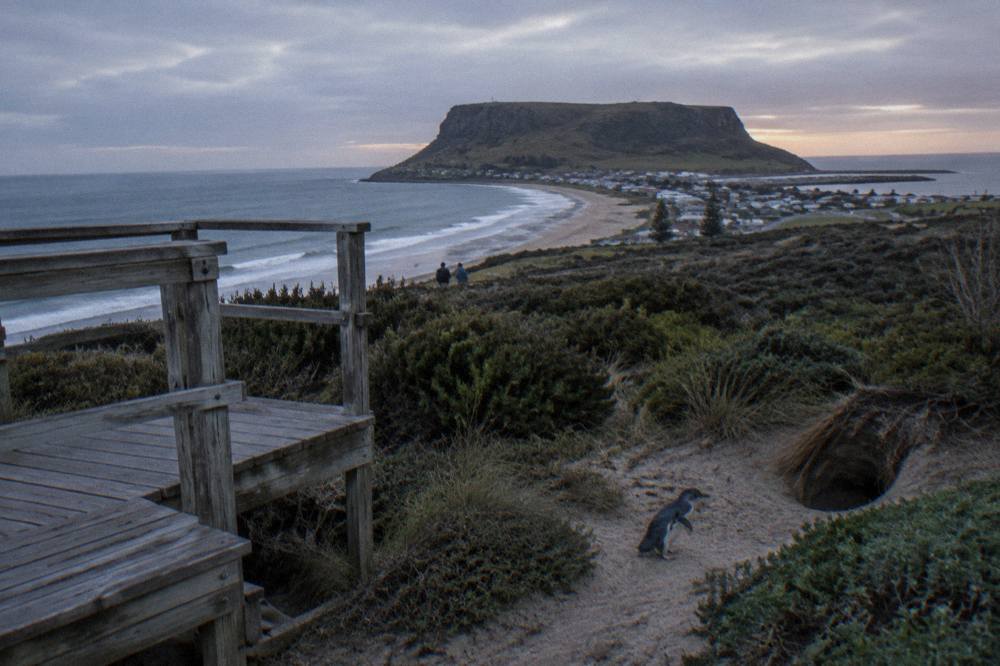
Tatlows Beach, closer to town, is the other spot locals mention. Both are free, both are unstaffed, and neither has the volunteer guide presence you would find at Lillico Beach near Devonport or Burnie further east along the coast. That is the honest trade at Stanley: no cost, no crowds, but also nobody to point out where the birds will land. The state's wildlife agency suggests, as general guidance, that joining a guided tour is the ideal way to watch little penguins, precisely because a guide manages light, noise and distance for you. At Stanley you are the guide. If you'd rather have guides on the beach with you, the Lillico Beach penguins guide near Devonport explains how that experience works.
| Spot | Location | Cost | What To Expect |
|---|---|---|---|
| Godfreys Beach platform | West of Stanley | Free | Reported red lighting, level access, main viewing point |
| Tatlows Beach | Near town | Free | Secondary spot, no infrastructure reported |
| Nut State Reserve surrounds | Under the Nut | Free | Named by Parks and Wildlife for dusk seabird viewing |
The platform and its features come from secondary local sources rather than an official parks page, so treat the details as reported rather than guaranteed. What is firm is the price: nothing. Stanley charges no fee, needs no booking and takes no bookings, because there is nothing to book.
When Is The Best Time Of Year For Stanley Penguins?
September to March is the reported best window at Stanley, matching the little penguin breeding season when activity at rookeries is highest. Numbers thin out from May to August, though the species is present year round. Moulting runs roughly February to April, when adults stay ashore for about two to three weeks while replacing all their feathers.
The little penguin's calendar drives everything here. According to the state's wildlife department, breeding commonly starts with nest preparation in winter, with clutches of two eggs laid as early as May or as late as December, incubation of about 35 days, and chicks fledging at around eight weeks. That long, loose season is why September to January tends to be the busiest period at rookeries: there is simply more coming and going, more feeding runs, more noise on the beach after dark.
Winter is not a write-off. Birds still return at dusk, and quieter months can mean a quieter beach for you, but the odds of a big raft of penguins landing together are lower. February to April is the moulting window, when adults fatten at sea and then sit tight in their burrows while their feathers renew, so evenings in early autumn can be hit and miss even in good weather.
| Period | Reported Activity At Stanley | Notes For Viewers |
|---|---|---|
| September to January | Highest, breeding season | Best odds, busiest beaches |
| February to April | Variable, moulting season | Adults ashore up to 2 to 3 weeks, fewer landings |
| May to August | Quietest | Some birds still return at dusk |
One caution worth carrying with the calendar: no official body publishes a "best month" ranking for Stanley or any other rookery, and no current colony count exists for the town's penguins. Anyone promising peak numbers for a specific month is guessing. The season pattern above is the defensible version, drawn from the species' biology rather than a local brochure.
Free Viewing Or A Guided Tour: Which Suits You?
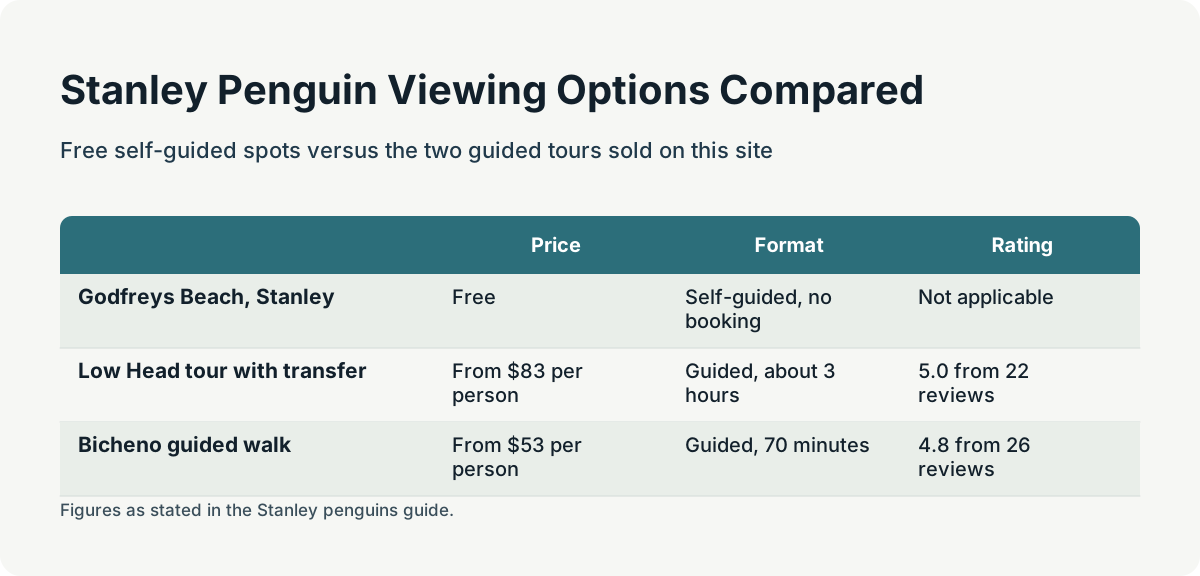
Godfreys Beach costs nothing and suits confident, quiet viewers happy to stand in the dark unaided. A guided tour adds a guide, supplied red lights and reliable timing: the Low Head tour runs from $83 per person with a maximum of 10 guests, and Bicheno's guided beach walk from $53. Both carry free cancellation.
The real difference is not price, it is certainty. At Stanley you choose a spot, wait, and hope the birds land within sight of you. On a guided tour, someone who watches the same rookery every night decides where the group stands, supplies the correct dim red lighting, and tells you when to stop talking. For families with children, photographers who want to stay within the rules, or anyone nervous about standing alone on a dark beach, that structure is worth real money.
The closest guided experience to Stanley sold on this site is the Low Head penguin tour with Launceston transfer, about three hours door to door from a central Launceston pickup, with roughly an hour of guided penguin viewing near George Town. It is rated 5.0 from 22 reviews, caps groups at 10 guests, and costs from $83 per person.
Further away on the east coast, the Bicheno penguin tour is a 70-minute guided walk from $53 per person, rated 4.8 from 26 reviews, and its listing is flagged as often selling out, so book early.
| Option | Price | Format | Rating |
|---|---|---|---|
| Godfreys Beach, Stanley | Free | Self-guided, no booking | Not applicable |
| Low Head tour with transfer | From $83 per person | Guided, about 3 hours, max 10 guests | 5.0 from 22 reviews |
| Bicheno guided walk | From $53 per person | Guided, 70 minutes | 4.8 from 26 reviews |
A third path sits between the two: the volunteer-run free viewing sites along the north coast, covered in our guide to free penguin viewing around Tasmania, where guides are present in season but no tour is sold. Stanley itself is not one of those, so if you want any human help on your penguin night, you will need to drive to it.
If your heart is set on Stanley's particular charm, the honest plan is to do both: a self-guided night at Godfreys Beach because you are already there, and a booked guided night at Low Head or Bicheno somewhere in the same trip, so the holiday contains at least one penguin encounter that comes with a guarantee of guidance.
A few practical points can help you decide between the two guided options. The Low Head tour includes a transfer from Launceston, which matters if you would rather not drive at night on unfamiliar roads after a long day of sightseeing; the trade-off is that the three-hour round trip eats into your evening, so it suits travellers who are happy to make the penguin viewing the main event of that day. Bicheno's shorter 70-minute walk leaves more of the evening free and is the cheaper of the two, but it sits on the opposite coast, so it only makes sense if your itinerary already takes you to the east coast rather than as a detour from Stanley.
Booking behaviour also differs. Because the Bicheno listing is flagged as often selling out, it is the one to lock in early once your dates are fixed, while the Low Head tour's small group cap of 10 guests means it too can fill ahead of peak travel periods. Both tours carry free cancellation, so you can book before your trip with confidence and adjust later if your plans shift, which is a flexibility the free Godfreys Beach option cannot offer in reverse: there is nothing to cancel, but also nothing to reserve, so you simply turn up and take your chances.
If you are travelling with children or anyone who tires easily, weigh the format as much as the price. A short guided walk with a guide on hand to point out birds and manage expectations tends to hold young attention better than a long quiet wait in the dark, while confident adult viewers often find the free Stanley night perfectly satisfying on its own.
What Time Do Penguins Come Ashore At Stanley?
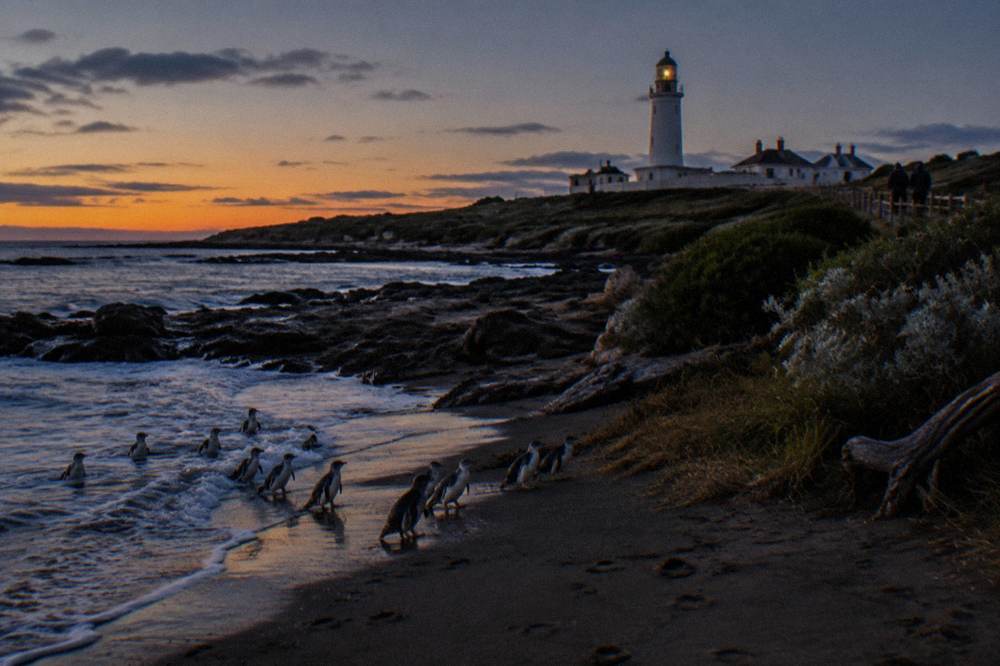
Little penguins leave the water at last light, and most come ashore in small groups within an hour or so of darkness, so settle into position at Godfreys Beach before the sun goes down. As a rough guide, Hobart-area sunset runs from about 6:20 pm in early October to near 8:50 pm in late December, so check the local sunset time for your date. If you're planning to catch the penguins further along the coast, the month-by-month timing guide for Burnie's penguin arrivals covers exactly when to show up at the Observation Centre.
That hour after darkness is the whole event. Birds raft together offshore, sometimes visible as a dark smudge on the water, then come in as a group because a crowd of penguins is safer than a single one. The state's guidance is blunt about what happens when they are disturbed: birds that feel threatened stay at sea longer, which stresses them and delays feeding of chicks. Arriving late, walking along the beach with a white torch, or letting a dog run the sand can push an entire evening's landing back past your patience.
Because Stanley has no tour, there is no operator to tell you tonight's meeting time, and no one to text you when the birds start landing. Give yourself a buffer: arrive while there is still enough light to find the platform, get settled, and let the beach go quiet around you. The birds will not adjust to your schedule.
What Are The Penguin Watching Rules At Godfreys Beach?
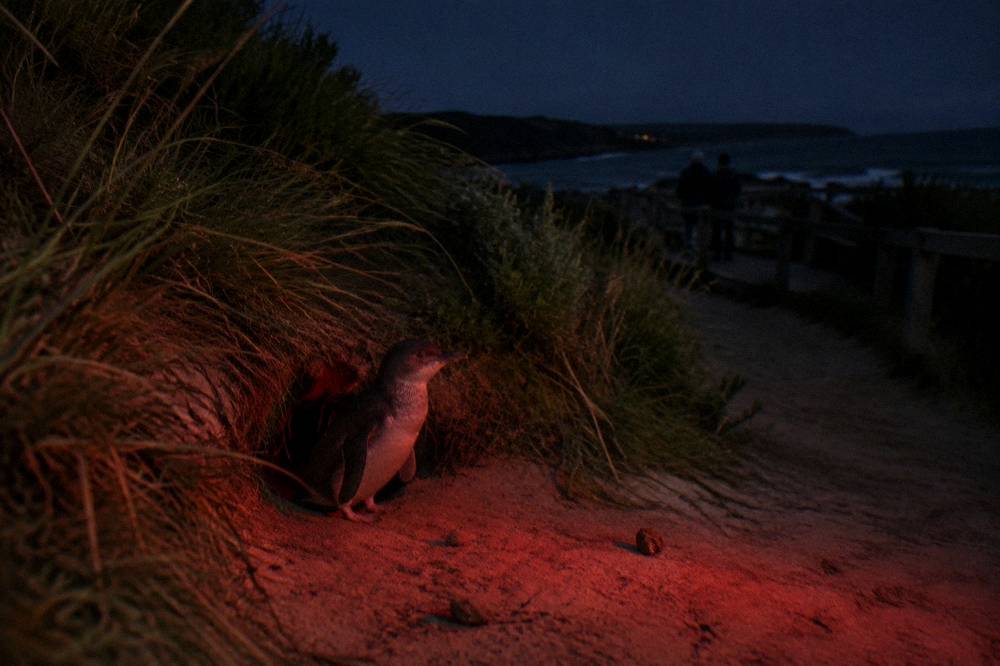
Wear dark clothing and enclosed shoes, approach from the land side rather than along the beach, stay at least 3 m from burrows, and settle into place before last light. Only dim red-light torches are permitted, never pointed at penguins or the water, and flash photography is banned on the beach. Dogs and cats are prohibited under any circumstances, even leashed.
These are not Stanley-specific suggestions. They are the state's published penguin watching guidelines, and they apply at every rookery in Tasmania, staffed or not. The full rules are on the wildlife department's penguin watching guidelines page, and they are worth reading before any penguin night, because at Stanley there is no guide to correct you.
| Rule | Why It Exists |
|---|---|
| No flash photography | Penguin eyes are adapted for night vision; a flash blinds and disorients them |
| Red-light torches only, dim | Red light disturbs night vision far less than white light |
| Stay 3 m from burrows, never block them | Birds need a clear path home to feed chicks |
| Approach from land, use existing tracks | Walking through the colony crushes burrows |
| No dogs or cats, even leashed | Dogs have wiped out whole colonies elsewhere in Tasmania |
| Settle before last light, stay quiet | Disturbed birds stay at sea, delaying feeding |
The last row carries real history. Bicheno's colony fell to about 40 birds in the early 1990s after dog attacks, and only recovered through years of land restoration by the local operator. That is the stakes-level context behind the leash rule: it is not bureaucracy, it is a memory of a near-miss. Binoculars are explicitly encouraged by the guidelines, and video without spotlights is fine, so the photography ceiling at Stanley is roughly the same as anywhere in the state.
How Do You Pair Penguins With The Nut And A Stanley Day?
The Nut and Highfield House fill a Stanley day before the evening penguin watch: the Nut State Reserve is the town's signature landmark, and the Parks and Wildlife Service lists it among Tasmania's dusk seabird viewing spots, while Highfield House is a separate daytime historic site. Aim to be at Godfreys Beach as the day trips wind down.
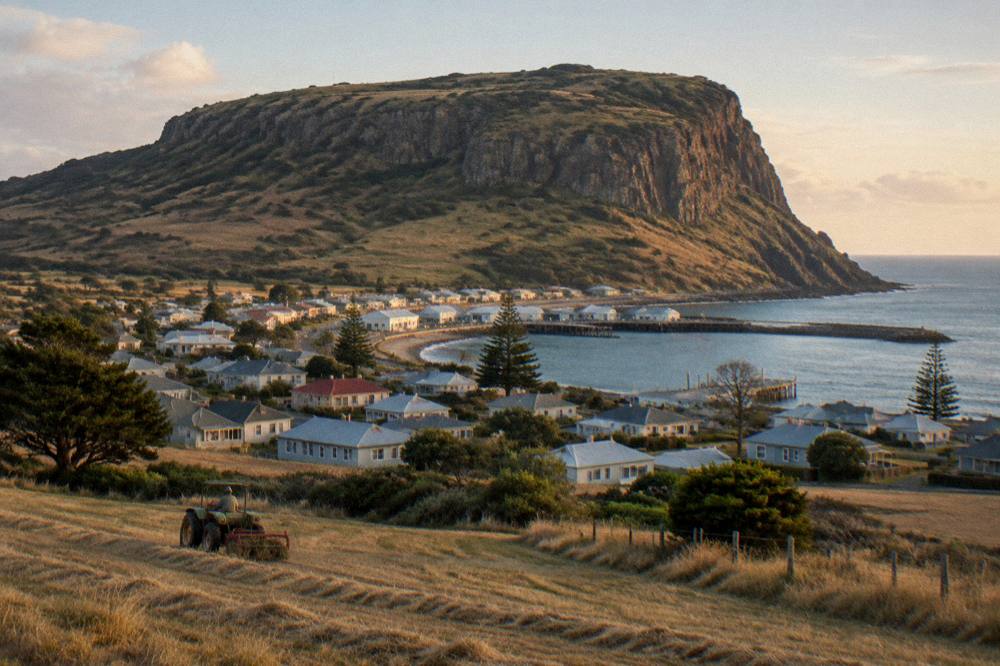
Stanley is small enough that a penguin evening slots into any day there (see Things To Do). The obvious pairing is the Nut itself, the basalt plug you can walk up or ride a chairlift up, which we cover in detail in our guide to the Nut at Stanley. Highfield House, the historic homestead on the headland above town, runs daytime hours and is a separate attraction entirely, so do not expect it to be part of the penguin experience.
A practical shape for the day looks like this: the Nut or Highfield in the afternoon, an early dinner in town, then out to Godfreys Beach with dark clothing and a red-light torch while there is still light to walk. Sunset in this part of the world moves fast, and the gap between "plenty of light" and "penguins are due" is shorter than visitors expect. If you are staying in Stanley, the walk or short drive to the platform is the easiest part of the trip.
Is Stanley Worth The Drive For Penguins Alone?
For penguins alone, Stanley is a bonus rather than a destination: viewing is free but self-guided, with no tour, no booking and no guarantee of a sighting. Travellers who want a guided penguin experience should plan it elsewhere, most easily from Launceston, where the Low Head tour runs about three hours door to door from a central pickup.
The honest framing is that people come to Stanley for the town, the Nut and the north-west coast, and the penguins are a free evening added on top. If a guaranteed penguin night is the point of your trip, base the penguin part of it around Low Head or Bicheno, where guided tours run nightly, and treat Stanley as the place you happened to also see penguins for nothing.
The north-west coast actually strings together nicely for penguin-minded travellers. East of Stanley, Burnie runs free volunteer-guided viewing nightly from 1 October to 31 March, covered in our Burnie penguins guide, and the same coast holds the Lillico platform near Devonport. A visitor comparing all of this at once, including the guided options, can start with the viewing-site comparison on Tasmania Penguin Tours and see the whole map of who runs what.
For the guided anchor of a north-coast trip, the Low Head tour remains the nearest bookable option on this site: from $83 per person, about three hours door to door including the Launceston transfer, roughly an hour of guided viewing at Low Head, a maximum of 10 guests, and free cancellation. Bicheno's walk, from $53, is the cheaper contrast if your route runs along the east coast instead, and its listing is flagged as often selling out, so it rewards booking ahead rather than deciding on the night.
Common Questions About Penguins In Stanley
Where can you see penguins in Stanley?
The main spot is the free Godfreys Beach viewing platform west of town, reported to have red lighting and level access, with Tatlows Beach as a second option. Both are self-guided; no tour operates in Stanley.
When is the best time to see penguins at Stanley?
September to March is the reported best window, with the breeding season from September to January bringing the most activity. Winter evenings are quieter but some birds still come ashore.
Is there a guided penguin tour in Stanley?
No. Stanley has no penguin tour operator. The nearest guided tour sold on this site is at Low Head, near George Town, from $83 per person with a Launceston transfer.
What time do penguins come ashore at Stanley?
Little penguins leave the water at last light and most land within an hour or so of darkness. Be settled at the platform before sunset, and check the local sunset time for your date.
Can you take photos of penguins at Stanley?
Yes, but never with flash, and only under the state rules: dim red light only, no torches pointed at penguins or the water, and video without spotlights is fine. The same guidelines apply at every Tasmanian rookery.
Is Godfreys Beach free?
Yes. Viewing at Godfreys Beach and Tatlows Beach is free, with no booking, no fee and no staffing. Bring your own red-light torch and dark clothing.