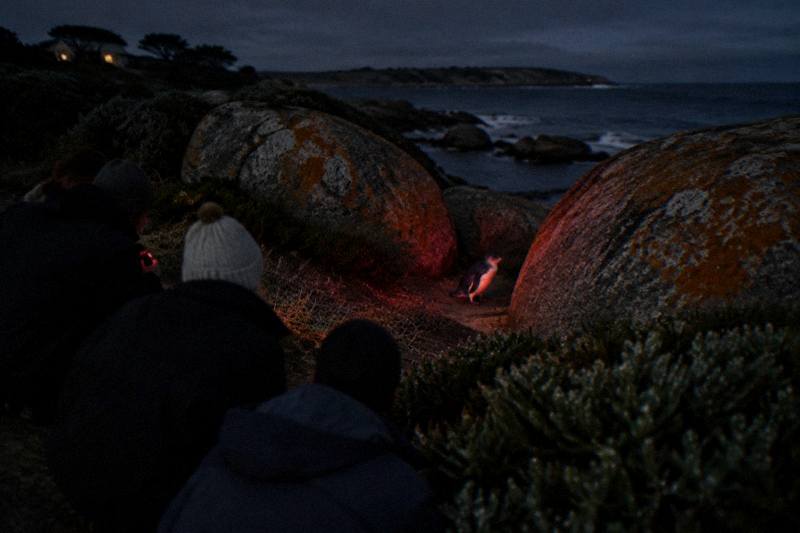
Why Can't You Take Photos Of Penguins In Tasmania?
Flash photography harms little penguins at dusk. Here is the reasoning behind the rules, what cameras are allowed at Bicheno and Low Head, and how to take permitted photos safely.
Why Can't You Take Photos Of Penguins In Tasmania?
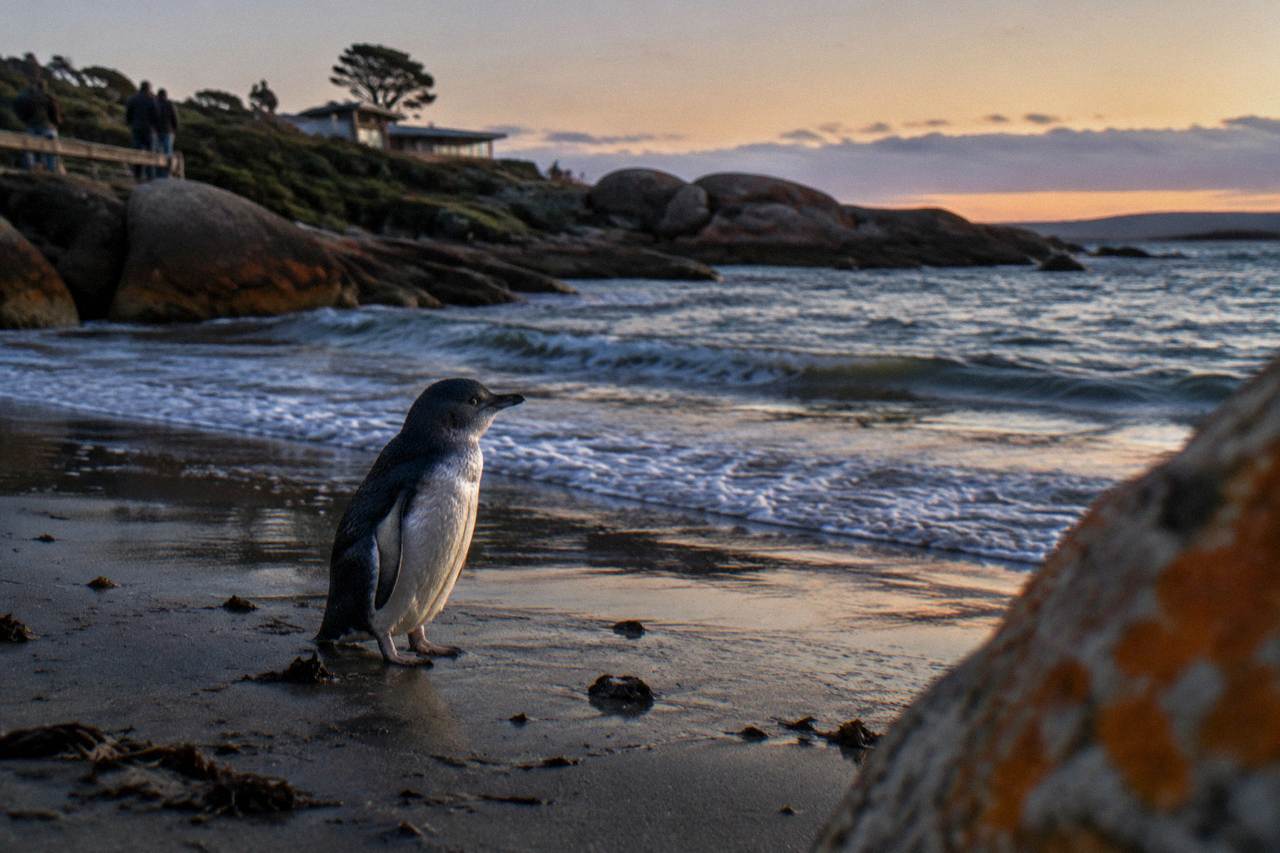
You cannot take flash photos of penguins because little penguins come ashore at last light, when their eyes are adapted to near darkness, and a flash or bright torch can scare them back into the water. The state guidelines are blunt about the consequence: disturbed birds stay at sea longer, which stresses them and delays the feeding of chicks. Photos without flash are generally fine. For tips on where and when to spot little penguins around the state, see our guide to where little penguins live in Tasmania.
That is the whole rule in one sentence, but the reasoning behind it deserves a proper explanation, because it changes how you behave on a beach at dusk. A little penguin is the smallest penguin species in the world, about 40 cm tall and around 1 kg as an adult. It spends its days fishing at sea and returns to its burrow after dark, usually in small groups within an hour or so of nightfall. Everything about that return depends on the bird feeling safe: it waits in the swell, gathers in rafts offshore, and only commits to the beach when the light is low enough that predators cannot see it clearly.
A camera flash, a phone torch or a bright headbeam recreates the one condition the penguin is trying to avoid, full daylight exposure. The bird's response is predictable. It turns around, swims back out, and waits. The Penguin Watching Guidelines published by NRE Tasmania spell out the effect: disturbed birds stay at sea longer, which stresses them and delays the feeding of chicks waiting in the burrow. One photo is not a catastrophe. A whole beach of visitors doing it every night, at a rookery where chicks are waiting to be fed, is a genuine problem for the colony.
This is also why the rules are stricter than most visitors expect. It is not that penguins are fragile creatures that must never be seen. They are watched every night of the year at sites around Tasmania, by guided groups and by independent visitors, and the state's own advice is that a guided tour is the ideal way to see them. The restriction is narrow and specific: no flash, no bright lights pointed at the birds or across the water, no white torch beams sweeping the beach. Dim red light is the exception, and even that has conditions.
The practical takeaway for anyone planning a trip is simple. You can bring a camera. You can take photos. You just cannot use flash on the beach, and you cannot light the scene. The results are actually better than you might think, because a penguin silhouette against a fading sky, shot in natural dusk light, is a far more honest photograph than a flash-lit bird with glowing eyes. The photography rules are covered in more detail in the site's guide to penguin photography rules in Tasmania, including what settings work in near darkness.
For visitors who want the best chance of actually seeing penguins rather than guessing where to stand, the two guided options below handle the light discipline for you. The guide carries the red torch, positions the group before the birds arrive, and tells you exactly when a camera is okay.
What Does Flash Actually Do To A Penguin's Eyes?
A little penguin's eyes are tuned for night vision, and a flash effectively blinds it for a stretch of seconds while it decides whether the beach is safe. The bird cannot know the light came from a phone, so it reacts as if a predator has found it, and it heads back out to sea. The delay is the real cost, because chicks in the burrow are waiting to be fed.
Human eyes adjust to a dark beach over several minutes. A penguin coming ashore has spent the whole day at sea and arrives already fully dark-adapted, which is exactly why it chose this hour. A flash fired at that moment is, to the bird, a spike of light many times brighter than anything in its night world. It does not interpret the burst as harmless. It interprets it as a sudden change in the environment, and the safe response programmed into it is to leave.
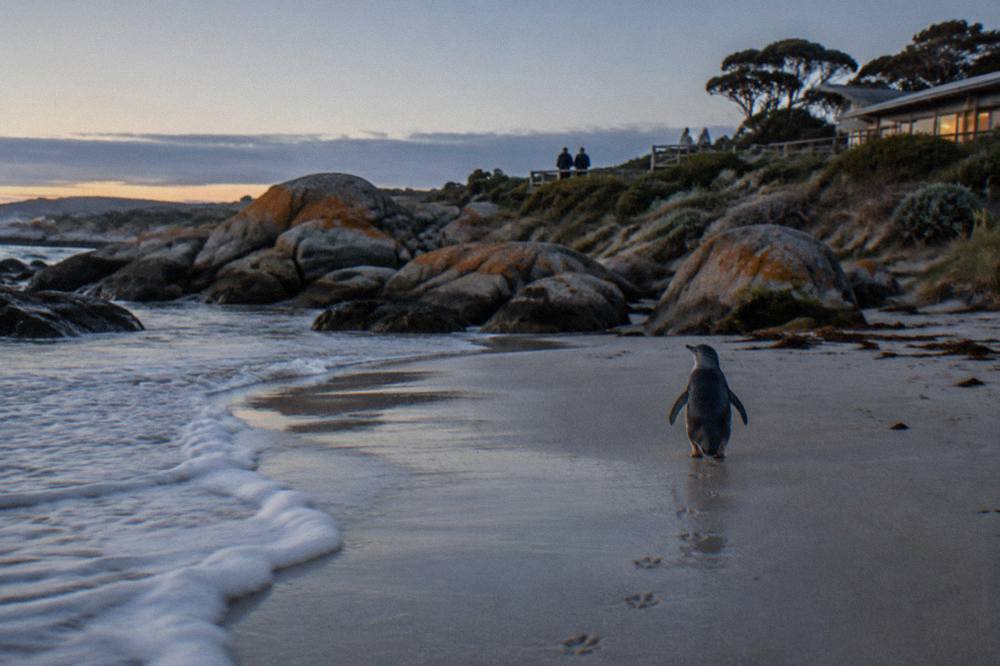
The NRE Tasmania guidance on little penguins in Tasmania describes the dusk return in detail: most birds come ashore in small groups within an hour or so of darkness. That window is tight. A bird that is pushed back out to sea by a light does not simply wait five minutes and try again. It loiters offshore, burning energy, and the feeding run for its chicks slips later into the night. During breeding season, September to January at most sites, that lost time matters most, because chicks fledge at about eight weeks and depend on steady nightly feeds.
There is a second, less obvious reason flash fails photographically. Penguins at a rookery are almost never close enough for a phone flash to reach anyway. What a flash actually does at typical viewing distances is light up the sand, the back of the head in front of you, and nothing else, while destroying your camera's own ability to gather the ambient dusk light. Turn the flash off, brace the camera, raise the exposure, and the scene looks like it actually looked. That is the version worth keeping.
Red light is the sanctioned compromise. A dim red torch, or a normal torch wrapped in red cellophane, is the only artificial light the state guidelines permit at a viewing site, and even then it must never be pointed toward the water or directly at a penguin. Red sits at the edge of what the birds process as bright light, so a low red beam lets a guide move a group safely without triggering the daylight alarm. That is why every guided penguin tour in Tasmania hands you red light and takes your white torch away at the start.
Which Photos And Videos Are Allowed On The Beach?
Photos without flash are allowed, and video without spotlights is explicitly fine under the state guidelines. What is banned is the light, not the lens: no flash, no white torches, no beams across the water, no lights aimed at the birds. A camera that can work in natural dusk light, or a phone held steady in the dark, is within the rules at every site.
The guidelines draw the line at illumination rather than equipment, which surprises people who assumed all cameras were banned. Video recording without spotlights is named as acceptable. Binoculars are recommended, which tells you something about the intended experience: the state wants you to watch closely, in the dark, from a settled position, rather than document the beach with light. A tripod is a separate question, and at Low Head the operator's own rules answer it, more on that below.
What this means in practice is that your best images come from preparation rather than gear. Arrive before last light, while you can still see the sand, and pick your spot. Set your camera or phone to a high ISO and a wide aperture, disable the flash entirely so it cannot fire by accident, and let your eyes adjust. When the penguins come ashore they will be shapes against the water, and that is the honest photograph: a colony at dusk, doing what it does every night, undisturbed by you.
The same logic extends to behaviour around the camera. The guidelines ask visitors to stay quiet, keep movement minimal, and settle into position before last light so the birds do not arrive to find a group still shuffling and chatting. Fumbling with a phone, checking a bright screen mid-viewing, or firing up a screen at full brightness to frame a shot are all small versions of the same problem a flash creates. Dim your screen, or cover it with your hand. The birds see the glow too.
Deciding between a guided evening and a self-guided one is partly a photography decision. A guide carries the red light, knows where the penguins will land, and runs the group so nobody has to improvise in the dark. If you are weighing the options, the site's comparison of Bicheno versus Low Head penguin tours covers the practical differences, including how each operator handles cameras.
What Are The Camera Rules At Bicheno And Low Head?
At Bicheno, photography is permitted without flash, and the operator says so plainly on its tour pages. At Low Head, flash is prohibited, visitors cannot bring their own torches, and selfie sticks and tripods are banned, with guides supplying low-intensity red and yellow lights instead. Both tours are otherwise camera-friendly, dusk-lit experiences.
The two guided tours on this site take slightly different approaches to the same problem. The Bicheno tour, a 70-minute guided experience from $53 per person, rated 4.8 from 26 reviews, runs a short bus ride from the operator's shop on Burgess Street to a private rookery, then a guided walk of about 500 m over roughly 50 minutes. Photography is permitted without flash. Enclosed shoes are required, there are no toilets at the rookery, and the listing is flagged as often selling out, so advance booking is the practical advice. Free cancellation applies. Other pages covering the same trip are gathered on Tasmania Penguin Tours.
The Low Head tour, from Launceston, is about 3 hours door to door including central pickup and transfer, with around an hour of guided penguin viewing at Low Head near George Town, from $83 per person. It holds a 5.0 rating from 22 reviews and caps the group at 10 guests. Its camera rules are stricter on gear: no torches, no selfie sticks, no tripods, flash prohibited, with red and yellow low-intensity lights provided by the guides. Free cancellation applies here too.
| Rule | Bicheno Guided Tour | Low Head Guided Tour |
|---|---|---|
| Flash photography | Not permitted | Not permitted |
| Non-flash photos | Permitted | Permitted |
| Personal torches | Red light guidance applies | Not allowed, guides supply red and yellow lights |
| Selfie sticks and tripods | Not addressed as a ban | Not allowed |
| Group size | Not stated as a cap on the listing | Maximum 10 guests |
| Time on the evening | 70 minutes | About 1 hour with the guide, about 3 hours door to door with transfer |
The stricter gear list at Low Head is not a judgement about photographers. It reflects the physical setting: a small group on a coastal reserve where a tripod in the dark is a trip hazard and a selfie stick is a silhouette the penguins read as a threat. Bicheno's walk covers about 500 m of track, where the guide's red torch is the only light the group needs. In both cases the operator is enforcing the state guidelines with local knowledge, and in both cases the penalty for ignoring them is the same one the guidelines describe, birds that stay at sea.
One point worth knowing before you book either evening: the rules apply from the moment the group reaches the viewing area, not from sunset. Guides typically brief the group on the walk in, which is the moment to ask about your camera. Asking after the penguins have landed means whispering in the dark, and the answer will not change. If you'd rather skip the guided walk entirely, our guide to seeing penguins in Bicheno without a tour explains what independent viewing actually involves.
How Do The Official Penguin Watching Guidelines Work?
The NRE Tasmania guidelines ask for dark clothing, an approach from land rather than along the beach, existing tracks only, a spot at least 3 m from burrows, settling in before last light, quiet movement, and dim red light only, with no dogs or cats under any circumstances. They also state that catching or harassing penguins is illegal, because the species is protected in Tasmania. Since those protections raise obvious questions about handling the birds, our guide to whether you can touch a fairy penguin covers exactly what the law allows.
The full list reads like common sense once you understand the bird's evening. Dark clothing matters because a pale jacket on a dark beach is a visible shape, and visible shapes are what the penguins are scanning for as they raft offshore. Approaching from land, using existing tracks and never walking through the colony, matters because a human silhouette between the water and the burrows blocks the exact route the penguins need. Staying at least 3 m from burrows, and not blocking them, protects the birds already ashore, including partners incubating eggs or sheltering chicks.
| The Guidelines Ask For | The Reasoning |
|---|---|
| Dark clothing | A pale shape on a dark beach reads as a predator |
| Approach from land, never along the beach | Walking the shoreline blocks the penguins' landing route |
| Stay at least 3 m from burrows | Burrows hold incubating adults and chicks |
| Settle before last light | Birds arriving to a moving group turn back |
| Quiet, minimal movement | Noise and motion delay the landing |
| Dim red torches only, never toward the water | Red light is the only beam the birds tolerate |
| No dogs or cats, even leashed | Dogs can kill many birds in one night |
| No flash on the beach | Disturbed birds stay at sea, delaying chick feeding |
The no-dogs rule deserves its own emphasis, because it is the one that has done measurable damage. The Bicheno colony's own history includes a collapse to about 40 birds in the early 1990s after dog attacks, followed by a recovery driven by land restoration work. That number is the operator's own account of its rookery's past, and it is the clearest illustration of why the guidelines treat pets as a hard no rather than a courtesy. A single dog in a colony at night can undo years of recovery.
For clothing and packing, the site's guide on what to wear on a penguin tour covers the layers, the enclosed shoes both operators require, and the red-light kit worth carrying if you are viewing independently. The short version: warm, dark, quiet, and nothing that lights up.
Can You Take Photos At The Free Viewing Sites Too?
Yes, at Lillico Beach, Burnie, Stanley's Godfreys Beach and the Penguin township beaches, the same rule applies everywhere: no flash, no white torches, red light only, and quiet. The free sites simply have no guide to enforce it, so the discipline is entirely yours, and the volunteer guides where they exist, at Lillico and Burnie, carry the red torches for the group.
The free sites are where the rules get tested most, because there is no operator briefing and no group to keep you honest. Lillico Beach, ten minutes west of Devonport, has a volunteer-run viewing platform generally used September to April, with two or three guides on site in season holding red torches; visitor torches and flash are not allowed, and donations are welcome. Burnie runs free guided viewing nightly from 1 October to 31 March, with guides at the Observation Centre from 30 minutes before dusk; no booking is needed, the boardwalk is level and wheelchair accessible, and again no flash. Stanley's Godfreys Beach platform has red lighting installed and is pram and wheelchair accessible. The Penguin township on the north-west coast is self-guided only at its local beaches, free, dusk viewing, red light only, with no organized tours currently running.
The photography answer at all of them is identical to the guided tours: shoot without flash, in natural light, from a settled position. The difference is that at a free site you choose the spot, so the guidelines become your checklist. Approach from land. Stay off the sand where the birds land. Keep 3 m from anything that might be a burrow, and if you cannot tell what is a burrow, that is the signal to stay further back rather than closer. Settle before last light and let the dark come to you.
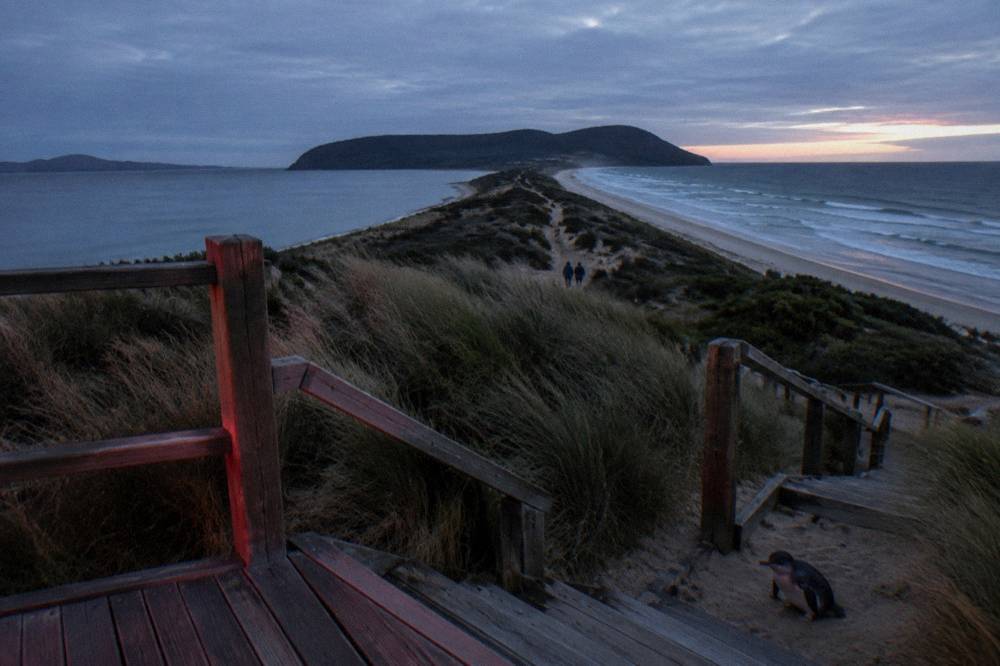
The Parks and Wildlife Service seabirds and shorebirds page names the recognised viewing spots, including the Neck Conservation Area platform on Bruny Island, the Lillico platform, Low Head Lighthouse, the Burnie platform and The Nut at Stanley. At Bruny specifically, the platform is the named viewing point, and the site's guide to penguins on Bruny Island explains what is and is not known about visiting it. Where a detail like opening hours or fees is not published on an official page, this site says so rather than guessing, and you should check with the Parks and Wildlife Service before you go.
One last point that ties the whole question together. The reason the rules feel strict is that they are protecting a nightly event that is genuinely fragile, not a spectacle that happens regardless. A colony that is disturbed every night stops coming ashore at that beach, and the visitors who followed the guidelines lose the show along with the ones who did not. The camera rules are the cheapest possible price for a front-row seat, and the best photographs of little penguins, the ones that survive being looked at more than once, are all taken without flash anyway.
Common Questions About Penguin Photography
Why Can't You Take Photos Of Penguins?
You can, as long as there is no flash. The restriction is on light, not lenses: little penguins come ashore in near darkness, and a flash or bright torch sends them back out to sea, delaying the feeding of their chicks. Photos and video in natural dusk light, without spotlights, are allowed under the state guidelines.
Can You Use A Phone Camera On A Penguin Tour?
Generally yes, with the flash disabled before the tour starts. At Bicheno, photography without flash is permitted. At Low Head, flash is prohibited and selfie sticks and tripods are not allowed, with guides supplying red and yellow low-intensity lights. Dim your screen brightness, because a bright phone screen is a small version of the same problem.
Why Is Red Light Okay But White Light Is Not?
Red light sits at the edge of what a dark-adapted penguin processes as bright, so a dim red beam lets guides move a group without triggering the birds' predator alarm. White light and flash read as daylight exposure. The state guidelines allow dim red torches only, and never pointed toward the water or directly at a penguin.
Can You Take Videos Of Penguins?
Yes. The NRE Tasmania guidelines explicitly accept video recording without spotlights. The same rules apply as for stills: no flash, no bright lights, no beams across the water, and settle into position before last light so the arriving birds are not disturbed.
What Happens If You Use Flash Anyway?
The penguins turn back to sea, and the delay stresses them and postpones the feeding of chicks in the burrow. On a guided tour you will be asked to leave. Beyond the ethics, penguins at viewing distance are too far away for a phone flash to reach, so the photo fails technically as well.
Where Can You See Penguins Without A Tour?
Lillico Beach near Devonport, the Burnie Observation Centre, Godfreys Beach at Stanley and the beaches around the Penguin township all offer free viewing, with the same no-flash, red-light-only rules. Lillico and Burnie have volunteer or guide presence in season. The site's guide to free penguin viewing in Tasmania lists the details.