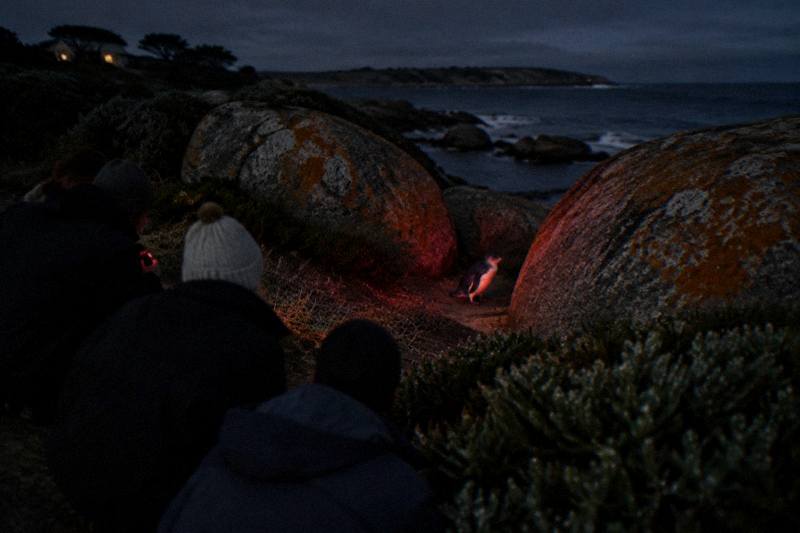
Can You Touch A Fairy Penguin?
No, you cannot touch a fairy penguin in Tasmania. Little penguins are protected wildlife, harassing or catching them is illegal, and the viewing rules keep you well back. Here is what the law says and what to do instead.
Can You Touch A Fairy Penguin?
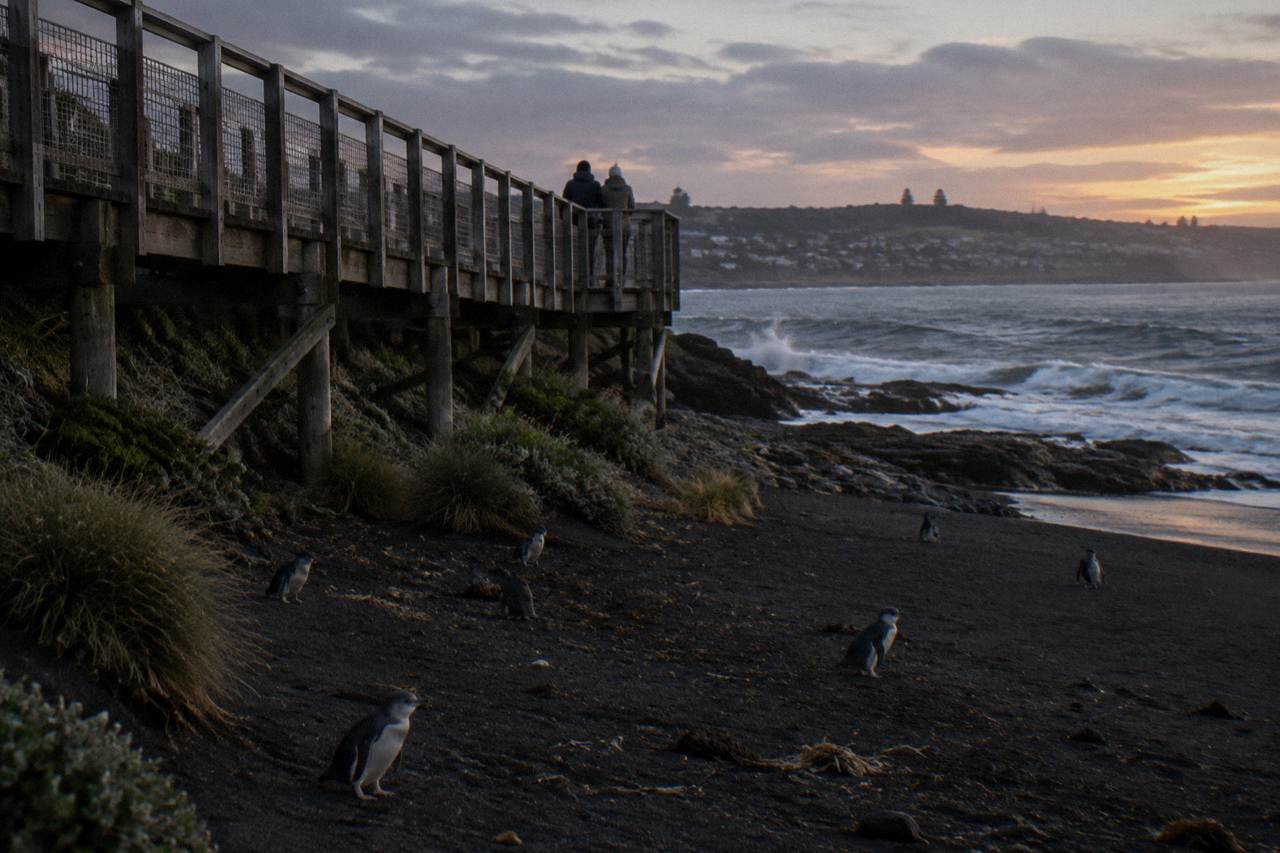
No. Touching a fairy penguin is not allowed anywhere in Tasmania, and it is more than a courtesy rule: little penguins are protected wildlife, and catching or harassing them is illegal. The official guidelines ask visitors to stay at least 3 m from burrows, never walk through a colony, and report problems to a ranger rather than intervene. If you're weighing where to see penguins in Australia, our Phillip Island Penguin Parade versus Tasmania comparison covers the differences between the two experiences.
The bird itself is small enough that the temptation is understandable. An adult little penguin weighs about 1 kg and stands around 40 cm tall, making it the smallest penguin species in the world. The name fairy penguin is the older, informal one, and it refers to exactly the same bird: the two names are interchangeable, which our little penguins versus fairy penguins guide covers in detail. Tasmania hosts the majority of the Australian population, with past state-level estimates of 110,000 to 190,000 breeding pairs, most of them on offshore islands.
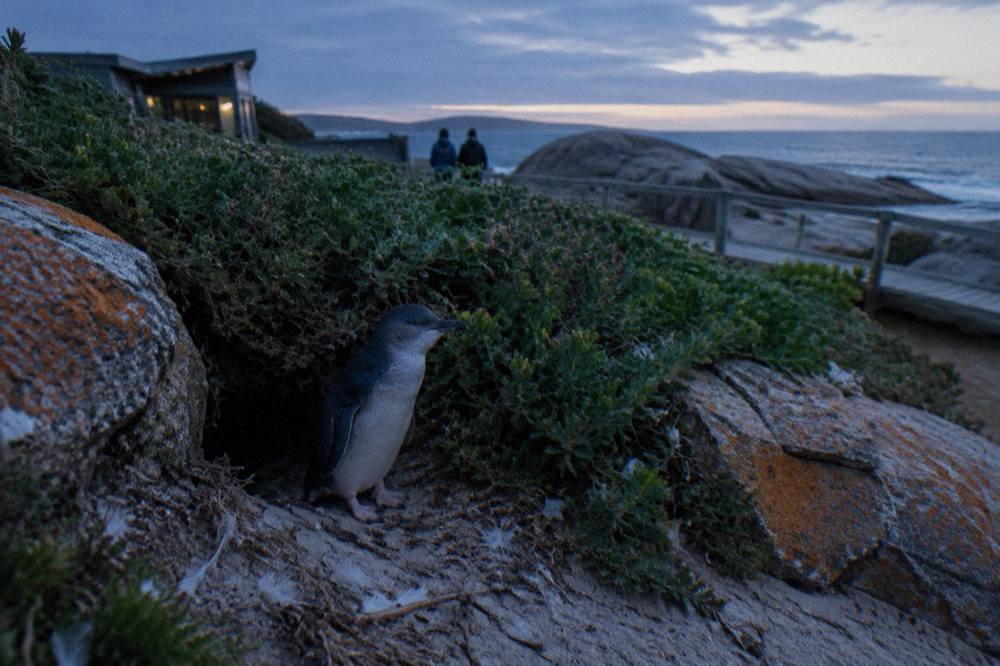
That abundance does not translate into access. The state's penguin watching guidelines from the Department of Natural Resources and Environment Tasmania are blunt about contact: penguins are protected, catching or harassing them is illegal, and anyone who sees a problem should report it to a ranger. The guidelines also publish the contact details for the Marine Conservation Program, 0427 942 537, which handles marine wildlife incidents across the state.
The rules are not there to spoil the moment. Penguins come ashore at last light in small groups, usually within an hour or so of darkness, after a full day of fishing. That return is the most fragile part of their day. Every guideline about distance, clothing and light traces back to one biological fact: a disturbed penguin stays at sea longer, which stresses the bird and delays the feeding of its chicks. If you want to see those evening arrivals for yourself, our guide to penguin spotting around Penguin in Tasmania covers where and when to watch responsibly.
If the goal is simply to be near these birds, a guided experience is the sanctioned way to do it, and there are two on this site worth comparing.
Why The Law Protects Penguins From Handling
Little penguins are protected wildlife under Tasmanian law, which means catching, holding or harassing one is an offence rather than a manners issue. The same protection covers their burrows, since a tunnel of 60 to 80 cm can hold eggs or chicks that a careless footstep destroys. Enforcement starts with rangers, and reports go through them. For a closer look at Tasmania's protected species in their natural settings, the Tasmania wildlife tours guide covers where to see penguins, devils and other animals responsibly.
Protected status is the legal spine of every viewing rule in the state. The department's little penguin page describes the species' biology and, in its own advice to visitors, says the ideal way to see them is on a guided tour. That recommendation is not marketing. Guides know where the birds land, they control the light, and they keep groups on tracks that the colony has already learned to tolerate.
The threats list explains why the state is so firm. Dogs and feral cats can kill many birds in a single night, which is why no dogs or cats are allowed at viewing sites under any circumstances, even leashed. Roadkill, harassment, vegetation burn-off, housing development, gillnet entanglement, oil spills and plastic ingestion all press on the same population. Handling by humans sits on that list too, because a penguin that associates people with danger may abandon a burrow entirely.
There is a history lesson embedded in one East Coast colony. The Bicheno rookery fell to about 40 birds in the early 1990s after dog attacks, and it recovered only after sustained land restoration work by the operator. A colony that can be reduced to 40 birds by a handful of incidents is not a population that can absorb casual handling by curious visitors. The law treats every individual bird as load-bearing.
It is also worth knowing what harassment legally includes. It is not only grabbing a bird. Shining a white torch at it, blocking its path from the water, standing over a burrow, or chasing one for a photo all fall within the spirit of the rules, and the guidelines are written to prevent each of those behaviours before they happen. The safest reading is simple: if your action changes what the penguin does, it is too much.
What Actually Happens When People Get Too Close
A penguin that feels threatened stays at sea longer, burns energy it needs for its chicks, and may delay feeding them by hours. The guidelines ask viewers to settle before last light, keep at least 3 m from burrows, approach from land rather than along the beach, and never walk through the colony.
The biology behind those rules is well documented. Penguins return in small rafts, timing their landing to darkness to avoid predators. A human silhouette on the beach reads as a predator. The bird loiters in the water, sometimes for a long time, and the chicks waiting in the burrow go hungry for that stretch. Multiply one nervous visitor by a whole evening of them, and a colony's nightly routine quietly collapses.
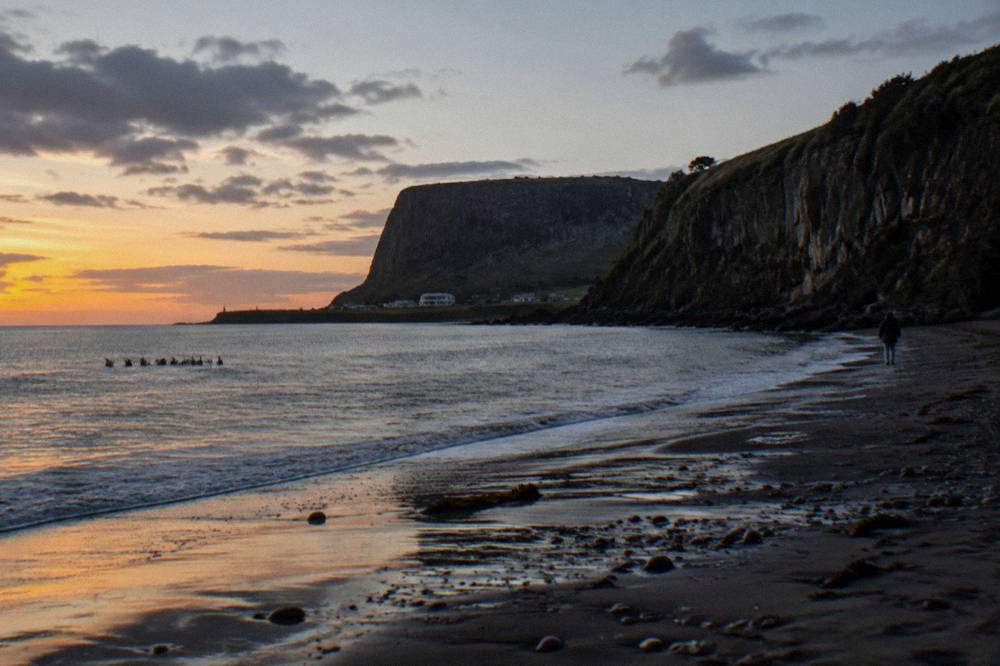
The distance rule deserves its own emphasis. The 3 m minimum applies to burrows, not just to birds, and it exists because a burrow can contain eggs or chicks invisible from the surface. The guidelines also ask viewers to pick a spot that does not block the path between the water and the colony, since penguins land and then walk inland to their nests. Standing in that lane, even quietly, forces them to detour or turn back.
Here is the full set of official behaviours, condensed from the guidelines:
| Rule | What It Means In Practice |
|---|---|
| Stay 3 m from burrows | Never block or stand over a nest tunnel |
| Approach from land | Do not walk along the beach where penguins land |
| Settle before last light | Arrive early and stay still once darkness falls |
| Dim red-light torches only | Red cellophane is acceptable, never point at penguins or the water |
| No flash on the beach | Video without spotlights is fine |
| No dogs or cats, ever | Even leashed animals are banned at viewing sites |
| Quiet, minimal movement | Voices down, no sudden gestures |
None of this is hard. It amounts to standing still in the dark, quietly, in the right place. The reward for patience is one of the better wildlife spectacles in Australia: groups of small birds wading out of the surf and trundling past within metres of people who are doing nothing at all. Curiosity about whether a penguin can be touched usually dissolves the first time one walks past your feet on its own terms.
What A Guided Tour Offers Instead
A guided tour replaces contact with proximity on the penguins' terms: a guide who knows the landing spots, controlled red lighting, a group that stays on the track, and a rookery where the birds are used to people. In Tasmania the two bookable options are the Bicheno beach walk and the Low Head tour from Launceston.
The Bicheno penguin tour is the East Coast option, and it is the one this site features. It runs from $53 per person, carries a rating of 4.8 from 26 reviews, and lasts about 70 minutes with the guide: a short bus ride from the operator's shop on Burgess Street to a private rookery, then a guided walk of about 500 m. Photography is permitted without flash, enclosed shoes are required, and there are no pickups from accommodation, so you meet at the shop. The listing is flagged as often selling out, and the operator advises booking ahead, especially in the September to January breeding season when activity at the colony peaks. Full details are on the Bicheno penguin tour page.
The Low Head tour is the North Coast counterpart, sold here with a Launceston transfer. It runs from $83 per person, is rated 5.0 from 22 reviews, and takes about 3 hours door to door, including central Launceston pickup and roughly an hour of guided viewing at Low Head near George Town. Groups are capped at 10 guests, guides supply low-intensity red and yellow lighting, and no personal torches, selfie sticks or tripods are allowed. The tour itself runs every night just after sunset year-round. More of these guides are collected on Tasmania Penguin Tours.
What both tours deliver, and what self-guided viewing cannot guarantee, is structure. The guide decides where the group stands, when it moves, and how the light is handled. The birds at these locations have decades of exposure to quiet, controlled groups, which is precisely why they keep coming ashore there. A visitor who follows the guide gets closer to penguins, safely and legally, than almost any solo attempt on a public beach.
| Bicheno Penguin Tour | Low Head Tour With Launceston Transfer | |
|---|---|---|
| Price | From $53 per person | From $83 per person |
| Rating | 4.8 from 26 reviews | 5.0 from 22 reviews |
| Duration | About 70 minutes | About 3 hours door to door |
| Group size | Guided walk on a private rookery | Maximum 10 guests |
| Region | East Coast, Bicheno | North Coast, via Launceston |
| Cancellation | Free cancellation | Free cancellation |
How To Watch Penguins Without Touching Them
Watch from a settled spot on land, in dark clothing, with no white light, at least 3 m from any burrow, and let the penguins walk past you. The guidelines spell out the behaviours, and a guided tour handles all of them for you: the only real decisions left are where to stand and what to wear.
Clothing matters more than most visitors expect. Dark colours help you disappear into the dusk, and warm layers matter because penguin viewing means standing still outdoors for an hour or more, often in coastal wind. Enclosed, comfortable shoes are required on the Bicheno walk and recommended everywhere. Our what to wear on a penguin tour guide breaks the packing list down by season.
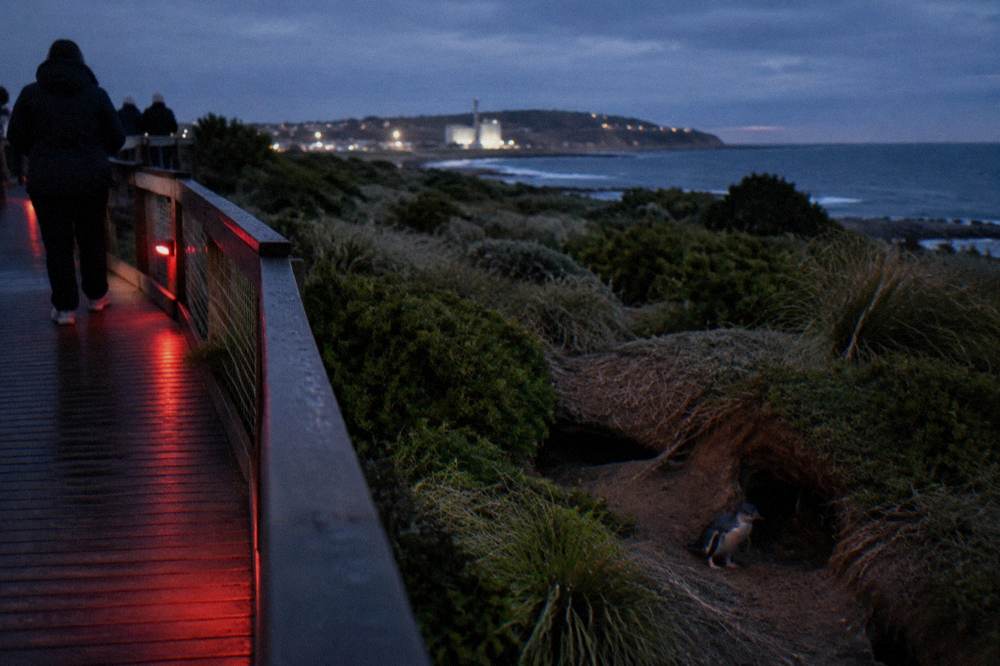
Light discipline is the second habit. White torches and phone flashes are off the table on any beach where penguins land, and flash photography is prohibited outright at both guided tours. Dim red-light torches, or red cellophane over an ordinary one, are the only artificial light the guidelines permit, and even those should never point at the water or directly at a bird. Photographers face the tightest limits of all, which is why we keep a separate page on the penguin photography rules in Tasmania.
The final habit is patience. Penguins do not run to a schedule that suits an audience, and numbers vary by season: September to January is the breeding window with the most activity, while February to April brings moulting birds that stay ashore, and the quieter season from February to August brings fewer penguins ashore, with moulting from February to April. Standing still in the dark for an extra twenty minutes is usually what separates a sighting from a story about the sound of penguins in the dunes.
None of these habits involve touching anything. The best penguin experiences in Tasmania are almost entirely passive, and that passivity is exactly why they work.
What To Do If You Find A Sick Or Injured Penguin
Do not touch it, do not pick it up, and do not try to feed or warm it. Note the location, keep people and dogs away, and report it: rangers for protected wildlife concerns, the Marine Conservation Program on 0427 942 537, and the Emergency Animal Disease Hotline on 1800 675 888 if the bird looks sick or dead.
The bird flu context makes this more than theoretical. H5 has been detected in Tasmanian wild birds, including little penguins on King Island, with 46 positive events recorded since 19 June 2026 according to Biosecurity Tasmania's bird flu page. No viewing-site restrictions have been announced, and the tours are running normally, but the reporting advice is now standard practice: avoid contact with sick or dead wildlife and call the hotline.
A penguin on a beach in daylight is not automatically in trouble. Moulting adults stay ashore for two to three weeks between February and April while they replace all their feathers, and they can look scruffy, stationary and entirely unbothered. A bird that is visibly injured, bleeding, unable to stand, or being harassed by dogs is another matter, and that is the moment to make a call rather than an intervention.
Handling the bird yourself fails on every axis. It is illegal under the protected wildlife provisions, it exposes you to whatever the bird is carrying, and it can turn a recoverable animal into one that has to be euthanised after a stressful capture. The professionals who answer those hotlines can dispatch a trained responder, and they log the incident into the wildlife surveillance system, which is how the state tracks what is actually happening along the coast.
The same logic applies to chicks. A lone chick outside a burrow is usually waiting for a parent, not abandoned, and moving it breaks the link between burrow and bird. The honest answer to the original question, can you touch a fairy penguin, ends here: the kindest thing a human can do for one of these birds is to be a pair of eyes and a phone number, nothing more.
If this has settled the question and you would rather just see the birds properly, both bookable tours below handle the rules for you.
Common Questions About Touching Fairy Penguins
Can You Touch A Fairy Penguin?
No. Little penguins, the same species Tasmanians call fairy penguins, are protected wildlife, and catching or harassing them is illegal. The viewing guidelines require at least 3 m from burrows and no walking through colonies. Report problems to a ranger rather than intervening.
Why Can't You Touch A Penguin Even If It Seems Calm?
A calm-looking penguin is usually a frozen one. Disturbed birds stay at sea longer, which delays feeding of their chicks, and repeated disturbance can make a colony abandon a site. Protected wildlife laws make any handling an offence regardless of how the bird reacts.
Can You Hold A Penguin For A Photo?
No. Handling a penguin for any reason, including photography, is harassment under the protected wildlife rules. Flash photography is also prohibited on penguin beaches, and both guided tours in Tasmania ban flash and personal torches outright.
What Do You Do If A Penguin Walks Right Up To You?
Stay still and stay quiet. If a penguin approaches on its own, that is the bird's decision, and the correct response is to let it pass without reaching out or blocking its path. Never follow it toward the water or into the dunes.
Who Do You Call About A Sick Or Injured Penguin?
Keep people and dogs away, note the location, and report it. The Marine Conservation Program handles marine wildlife incidents on 0427 942 537. Sick or dead seabirds should go to the Emergency Animal Disease Hotline on 1800 675 888, and should never be touched.
Can You See Penguins Closely Without Touching Them?
Yes, and often within a few metres. On a guided tour such as the Bicheno beach walk, from $53 per person, or the Low Head tour from Launceston, from $83 per person, the birds regularly pass close to a settled group. The guides control the light and the group's position, which is why the penguins keep coming ashore.