What To Wear On A Penguin Tour: Tasmania Packing Guide
Penguin tours in Tasmania run at dusk, on sand, in wind, in the dark, next to birds whose eyes are tuned to faint starlight. What you wear decides how cold you get and how many penguins you actually see.
Short answer
Wear dark, warm layers and enclosed comfortable shoes. Bicheno requires enclosed footwear for its roughly 500 metre rookery walk; Low Head bans selfie sticks and visitor torches. Bring no flash camera, no dog, no food scraps. Red light is supplied or restricted at every site. Tours run from $53 per person at Bicheno and $83 from Launceston.
Little penguins come ashore within roughly an hour of darkness, in small groups, onto beaches that are windy, sandy and cold even in January. The birds weigh about 1 kg and stand about 40 cm tall, and their eyes are built for faint light: the NRE Tasmania penguin watching guidelines ask visitors to wear dark clothing, stay quiet, and never point a bright torch at the water. Getting dressed for a penguin tour is therefore less about fashion and more about not being the thing that keeps the penguins offshore for the evening.
This guide covers the full kit for the two bookable tours on this site, the 70-minute Bicheno beach walk and the Low Head tour from Launceston, plus the free platforms at Lillico, Burnie and Stanley. It sets out what to wear, what to carry, what to leave behind, and why each item matters to the birds. The rules converge remarkably across every site on the coast, which makes packing simple once you understand the logic behind it.
What To Wear On A Penguin Tour In Tasmania?
Wear dark, layered clothing and enclosed comfortable shoes, and carry as little as possible. Dark colours stop you glowing against the dusk sky, layers handle the sharp temperature drop after sunset, and enclosed shoes are a stated requirement on the Bicheno tour's roughly 500 metre rookery walk. Leave the torch behind: guides supply red light where it is allowed.
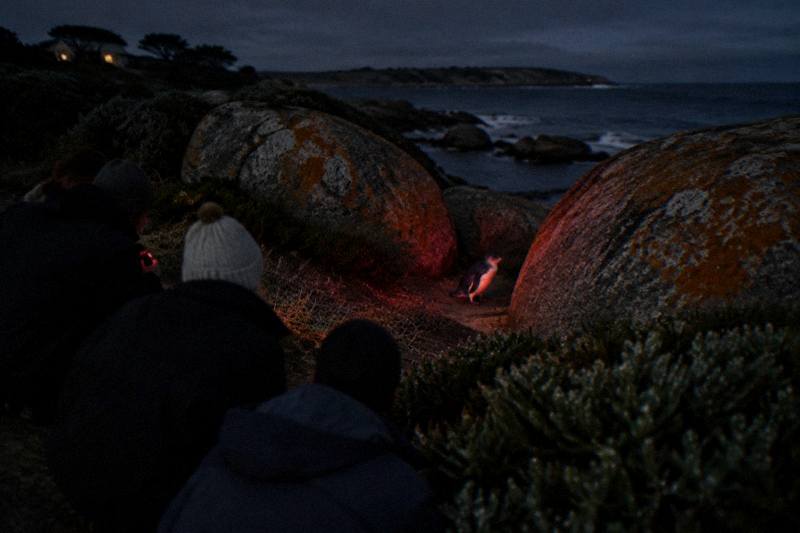
The starting point is colour. Little penguins judge risk by silhouette, and a pale jacket against a darkening beach reads as a large shape waiting at the waterline. The state guidelines are blunt about this: dark clothing, approach from land rather than along the beach, settle into position before last light, and keep movement to a minimum once the birds start arriving. Every item in the packing list below follows from that logic, and none of it is optional etiquette.
The second starting point is temperature. Tasmanian dusk in the breeding season, September to January, can still slide toward single digits on the coast, and the tours stand still for an hour or more. Standing still in wind is the coldest way to be outdoors, colder than walking the same track in the same clothes. Layers you can add and shed beat one heavy coat you cannot adjust, and a windproof outer layer matters more than thickness because the breeze comes straight off the Southern Ocean or Bass Strait with nothing between you and it.
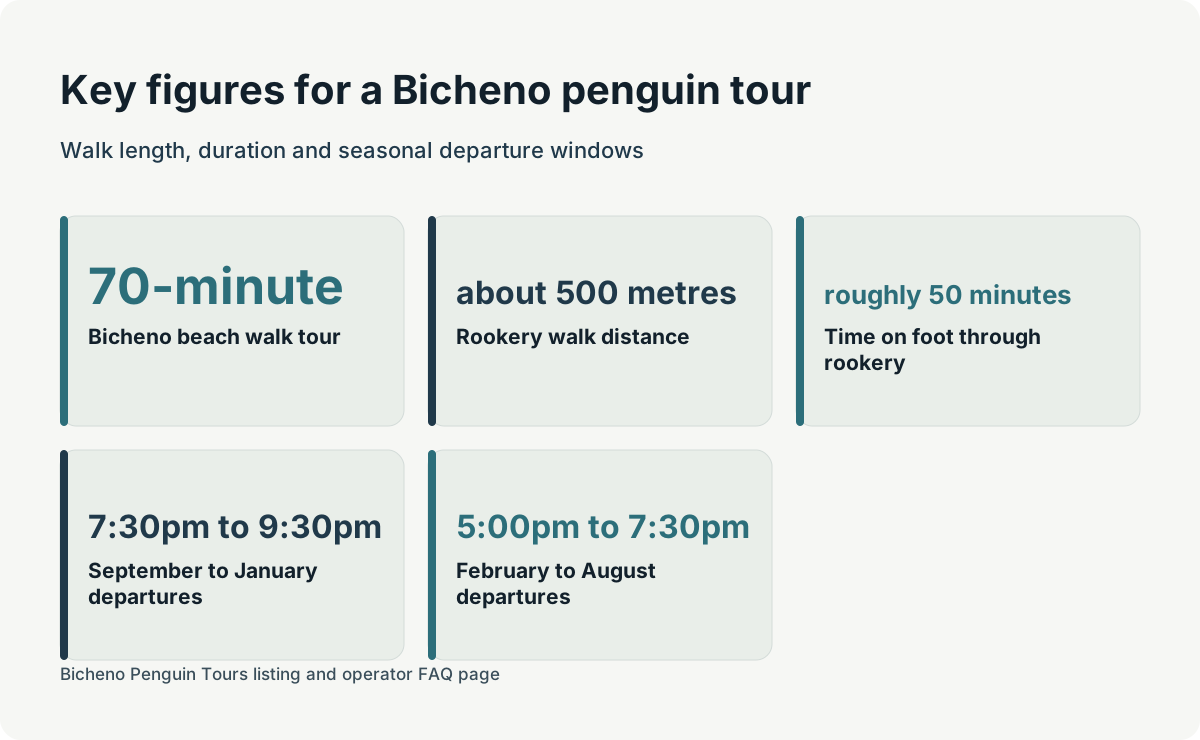
The third starting point is footwear, and here the two tours differ in a way that matters. The Bicheno operator states that enclosed comfortable shoes are required: the evening crosses a private rookery track of about 500 metres over roughly 50 minutes, and the operator's FAQ page repeats the requirement for every season. The Low Head tour near George Town moves through a coastal reserve with wheelchair access, so closed shoes are wise but the terrain is gentler underfoot. The full footwear comparison sits in its own section below.
One planning point worth settling early: the two bookable tours are genuinely different products, not two versions of the same evening. The Bicheno versus Low Head comparison walks through the trade-offs in detail, from group size to transfer logistics.
Why Does Dark Clothing Matter So Much?
Dark clothing matters because penguins read the horizon before they commit to land, and pale or reflective fabric breaks that horizon as a bright shape. NRE Tasmania's watching guidelines list dark clothing first among their recommendations. Wearing it is the cheapest thing you can do to improve your own night, and it costs the birds nothing.
The mechanism is simple. A bird floating in the shallows looks at the beach and sees the skyline. Anything light-coloured, whether a white hood, a hi-vis strip or a phone screen, breaks that skyline as a bright shape, and bright shapes mean predators to a small bird that has spent its whole life avoiding gulls and seals. The guidelines note that disturbed birds stay at sea longer, which stresses them and delays feeding of chicks. One badly dressed group at the waterline can hold a whole raft of penguins offshore while everyone waits in the cold.
Practically, dark means dark: navy, black, charcoal, dark green, muted browns. It does not mean one dark item over a white base layer, because the layer that shows is the one that counts. Jeans and a dark fleece are fine. A black rain jacket over a white long-sleeve shirt is also fine, since only the outer layer is seen from the water. The colour of your socks does not matter at all, while the colour of your beanie matters a great deal, because it sits at the exact height of the horizon line the birds are watching.
| Clothing item | Why it matters | Applies at |
|---|---|---|
| Dark outer layer | Keeps your silhouette low against the dusk sky | Every site, guided or free |
| Warm mid layer | Temperatures fall fast after sunset and tours stand still | Bicheno, Low Head, all platforms |
| Long trousers | Sand, wind and cold; you may sit or crouch on the ground | The Bicheno rookery walk especially |
| Beanie or dark hat | The highest visible point on your silhouette; retains heat | All sites, all seasons |
| Gloves for winter tours | Both tours run year-round; June to August is genuinely cold | Winter departures in the 5:00pm to 7:30pm window |
There is also a fairness angle that regulars on these beaches understand. At the free platforms like Lillico and Burnie, volunteer guides ask everyone to comply because one breach can spoil the night for forty other people standing quietly in the dark. At the paid tours the guide simply cannot let you stand where the birds land if you are dressed wrong, and you have paid for that spot. Dressing dark is how you protect your own evening as much as anyone else's.
What Shoes Do You Need For The Beach Walks?
The Bicheno tour requires enclosed, comfortable shoes for a guided walk of about 500 metres over roughly 50 minutes through a private rookery, and the operator's FAQ page states the requirement. Low Head's coastal reserve is flatter and wheelchair accessible, so closed shoes are a comfort choice there rather than a condition of entry. Sandals and heels fail both evenings.
The Bicheno walk is the reason this guide exists as a packing question rather than a casual suggestion. After a short bus ride from the operator's shop at 1/70 Burgess Street, the group moves on foot through the rookery, and the operator's FAQ page is explicit that enclosed comfortable shoes are required. The ground is a coastal reserve: soft sand in places, compacted track in others, and the operator notes there are no toilets at the rookery itself, so plan footwear you can walk in comfortably for close to an hour without a break.
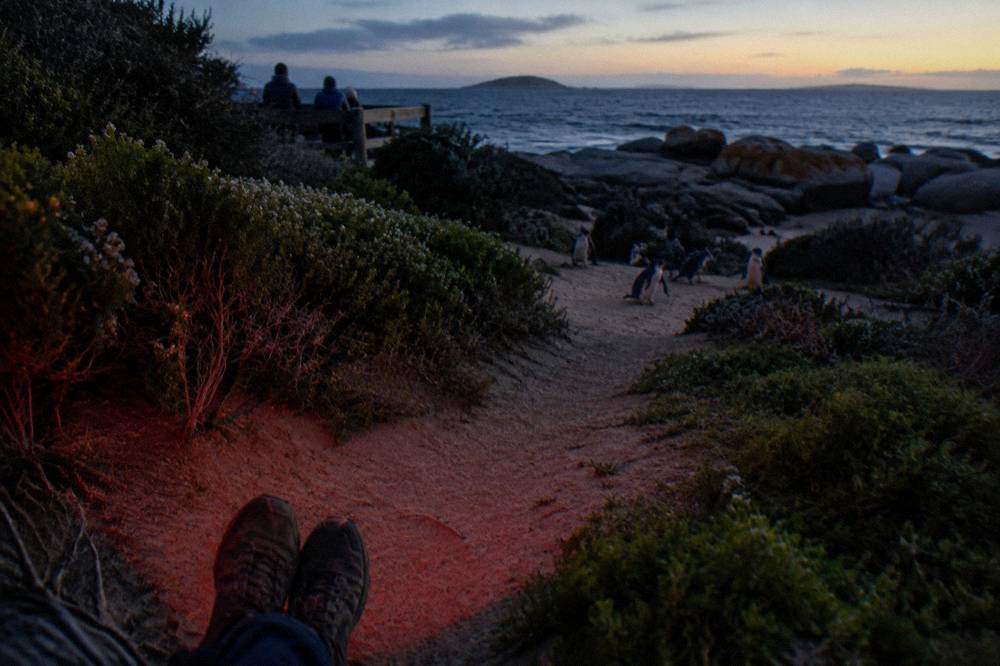
What works: runners, trail shoes, lightweight hiking boots. What does not: thongs, sandals, dress shoes, anything with a heel that can sink into sand or catch on a root. The operator handles wheelchair access case by case at Bicheno, so if that is relevant to your group, contact the operator through the listing before booking rather than assuming the track will suit.
| Footwear choice | Bicheno rookery walk | Low Head coastal reserve | Free platforms (Lillico, Burnie, Stanley) |
|---|---|---|---|
| Enclosed runners or trail shoes | Required, ideal | Ideal | Ideal |
| Lightweight hiking boots | Fine, may collect sand | Fine | Fine |
| Sandals or thongs | Not permitted | Poor: cold sand and gravel | Poor, and platforms are unlit after dusk |
| Dress shoes or heels | Not permitted | Risky on gravel paths | Risky |
Seasonal timing affects footwear comfort too. Bicheno departures run 7:30pm to 9:30pm in the September to January season and 5:00pm to 7:30pm from February to August, adjusted to dusk on the night. A winter departure means walking the track in the dark and cold, which is exactly when you want closed, grippy shoes rather than anything open. The listing is flagged as often selling out, and the operator advises booking ahead, so it is worth sorting your kit before the day rather than on the afternoon of. The Bicheno penguin tours guide covers the full evening sequence if you are weighing the two seasons.
How Do You Dress For Cold Dusk Wind On The Coast?
Dress in three layers under a windproof shell, because coastal wind drops the felt temperature sharply once the sun goes and penguin tours involve standing or walking slowly for an hour or more. Sunset near Hobart runs from roughly 6:20pm in early October to near 8:50pm in late December, so even midsummer tours finish in the dark.
The trap is summer. A January afternoon in Bicheno or Low Head can be mild and calm, and it is tempting to turn up in a t-shirt. But the tour starts at dusk and runs past dark, the sea breeze often strengthens rather than fades in the evening, and a still hour beside the water chills you fast. Guides on the coast see it every night in December: visitors who dressed for the afternoon shivering through the second half of the viewing window.
The layering system is straightforward. A base layer, long-sleeved and dark, then a fleece or wool mid layer, then a windproof outer shell. A shell that blocks wind is worth more than a thick parka that lets wind through, because wind chill is the dominant problem on these beaches. Add a beanie, since you lose heat from your head faster than anywhere else, and gloves for the February to August window when Bicheno departs as early as 5:00pm.
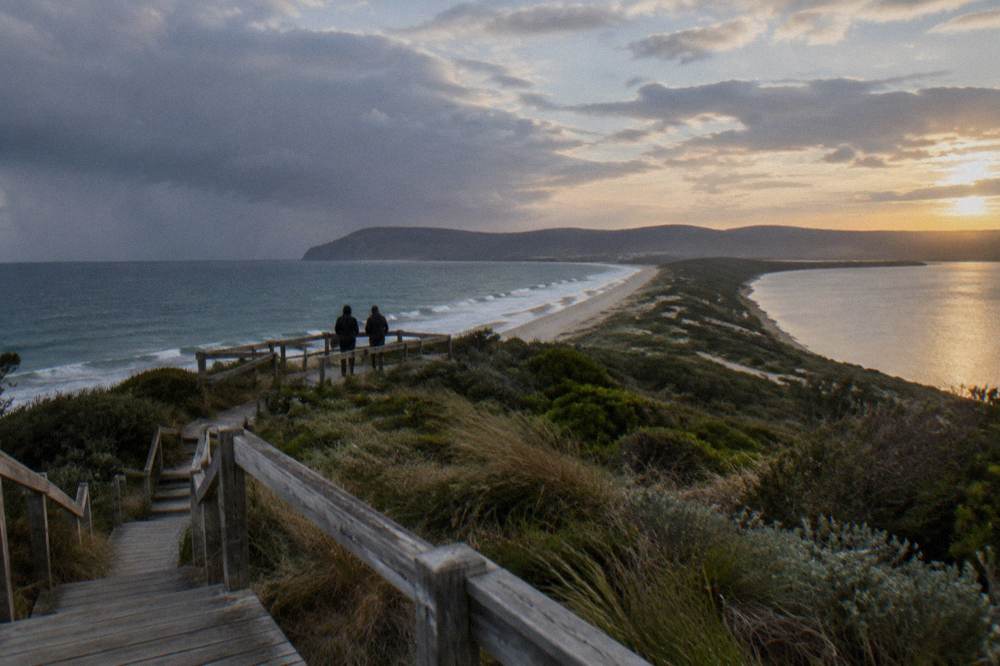
There is a bird-related reason for the quiet shell too. A flapping, crackling jacket is movement and sound, both of which the guidelines ask you to minimise once the birds are close. A fitted windproof layer that does not snap in the breeze keeps you warmer and keeps the beach quieter, which is the whole point of the evening.
| Layer | Job | Notes for penguin viewing |
|---|---|---|
| Dark base layer | Warmth next to skin, low visibility | Long sleeves; dark colour visible at the cuffs |
| Mid layer, fleece or wool | Insulation you can shed | Wool keeps working if sea spray dampens it |
| Windproof shell | Blocks the coastal breeze | Avoid stiff, noisy fabrics |
| Beanie and gloves | Heat retention in the winter window | Essential for 5:00pm to 7:30pm winter departures |
| Spare layer in the car | For the hour after sunset | Kept in the bus or vehicle, not carried onto the beach |
A few practical changes this season are worth knowing while you pack, because they change what you carry rather than what you wear.
Timing your evening around sunset is its own planning task, and the guide to when penguins come ashore explains the dusk window in more depth. The short version: most birds land within an hour or so of darkness, which means you will be standing in the coldest part of the day, dressed for wind, having packed one layer more than the afternoon told you to.
What Should You Never Bring On A Penguin Tour?
Never bring flash cameras, white torches, selfie sticks or tripods, dogs or cats, or food. Flash and bright light wreck the penguins' night-adapted eyes and can hold birds offshore; dogs and cats are banned outright under the state guidelines, even leashed; and food scraps attract the predators that raid burrows. Low Head bans selfie sticks and tripods by name.
The prohibitions are not etiquette, they are the terms of the evening. At Low Head the operator's tour details page states that no torches, selfie sticks or tripods are allowed, with guides providing low-intensity red and yellow lighting for the group. At Bicheno the operator permits photography without flash only, on the beach and along the track. At the free platforms the rules are just as firm: Lillico's volunteer guides hold the red torches and both visitor torches and flash are out, and Burnie's guides recommend red cellophane over any light you genuinely need in the car park.
The dog rule deserves emphasis because visitors underestimate it every summer. The NRE guidelines say no dogs or cats under any circumstances, even leashed, because a single dog can kill many birds in one night. Bicheno's own history makes this concrete: the operator tells how its colony fell to about 40 birds in the early 1990s after dog attacks, before land restoration helped the numbers recover. Leave pets at home, full stop, and that includes the well-behaved ones sitting quietly in the car.
| Item | Rule | Where it applies |
|---|---|---|
| Flash camera | Not permitted on the beach | Bicheno, Low Head, all free platforms |
| White torch | Not permitted; red light only, supplied by guides | Low Head supplies lights; Lillico guides hold them |
| Selfie stick or tripod | Banned by name at Low Head | The Low Head coastal reserve |
| Dogs or cats | Banned under all circumstances, even leashed | Every site, a state-wide guideline |
| Food and scraps | Take everything away; scraps attract predators | All colonies and reserves |
| Binoculars | Encouraged by the guidelines | All sites, especially the free platforms |
Binoculars are the one piece of gear the state guidelines actively encourage, and they neatly solve the photography problem. A small pair lets you watch birds closely without any light at all, which is the entire point of the evening. The photography rules guide covers what you can and cannot shoot and why the no-flash rule exists in the first place.
What Are The Red Light Rules At Each Site?
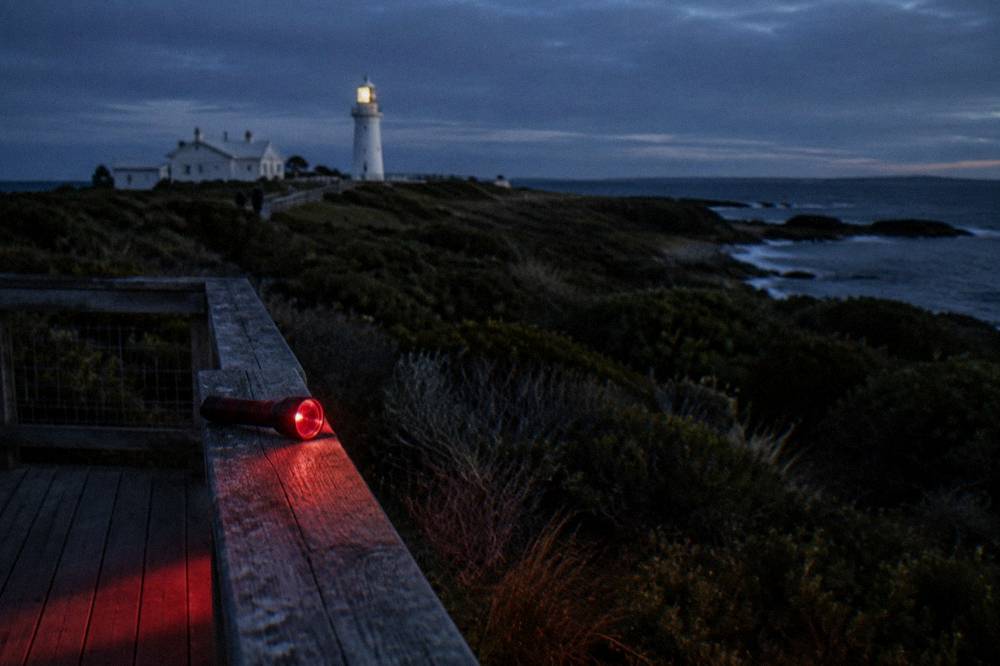
Red light is the only artificial light permitted around penguins at night, and dim red-filtered torches must never point at the water or directly at a bird. Low Head's guides hand out low-intensity red and yellow lighting, Lillico's volunteers hold the red torches, and Burnie recommends red cellophane over any beam. Video without spotlights is allowed.
The reason is physiology. Little penguins forage at sea in low light and their eyes are adapted for it; a white torch or a camera flash is a blinding event, and the guidelines note that disturbed birds simply stay at sea, delaying feeding. Red light sits at the low-energy end of their visual range, so a dim red beam lets a guide move a group along a track without scattering the birds. That is why every operator on the coast, and the volunteer programs, have converged on the same rule independently.
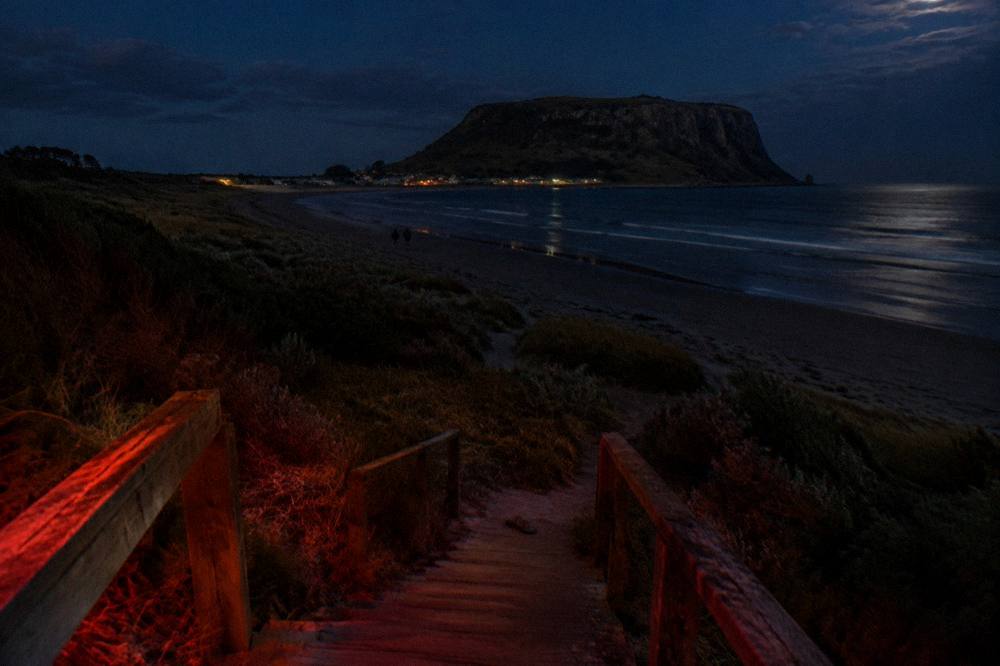
Practically, this means you bring nothing that glows. Do not pack a head torch, even a red one, because at the guided sites the guide controls the light and a dozen personal torches defeats the purpose no matter their colour. If you need light to find your footing at a free platform like Godfreys Beach at Stanley, where the boardwalk uses red lighting, let your eyes adapt instead: fifteen minutes of true dark gives you surprisingly good vision on a beach, and it costs nothing.
A few behaviour rules sit alongside the light rules and belong in the same breath. Stay at least 3 metres from burrows and never block them, approach from land rather than along the beach, and settle into position before last light so the penguins arrive to a beach that already looks still. Arriving early is a clothing decision as much as anything, because standing quietly for twenty minutes before dusk is precisely when the layers and the beanie earn their place in your bag.
How Does Packing Differ Between Bicheno And Low Head?
Bicheno needs walking kit: enclosed shoes, a warm dark layer and nothing you cannot carry on a 50-minute rookery walk, with no toilets at the viewing site. Low Head needs waiting kit: the from-Launceston listing runs about 3 hours door-to-door with roughly an hour of viewing, so warm layers matter more than footwear and luggage can stay in the vehicle.
The two tours reward slightly different bags. For Bicheno, think of it as a short hike that happens at night: grippy enclosed shoes, a warm dark layer, a beanie, and nothing in your hands, since you leave the bus and move on foot through the rookery with the group. The tour runs 70 minutes with the guide, from $53 per person, rated 4.8 from 26 reviews, with free cancellation on the listing.
For Low Head, think of it as an evening that includes a drive: the listing from Launceston is about 3 hours door-to-door with central pickup and transfer, roughly an hour of guided viewing at the reserve near George Town, and a maximum of 10 guests. You will spend real time standing on a flat reserve in the dark, so the warm layers matter more than the footwear, and anything you do not need can stay on the bus. The listing runs from $83 per person, rated 5.0 from 22 reviews. The operator's own page separately lists a direct adult price of $50 without the Launceston transfer, which is worth knowing if you have your own car.
| Packing question | Bicheno tour | Low Head with Launceston transfer |
|---|---|---|
| Footwear priority | High: 500 m rookery walk, enclosed shoes required | Low: flat, wheelchair-accessible reserve |
| Warm layers priority | High: standing and walking on an exposed beach | High: about an hour standing still in the dark |
| Toilets on site | None at the rookery; go before the bus ride | Pilot Station facilities closed; go in George Town |
| What stays behind | Torches, flash cameras, food, pets | Torches, selfie sticks, tripods, food, pets |
| Time on tour | 70 minutes with the guide | About 3 hours door-to-door |
| From price | From $53 per person | From $83 per person |
Both listings carry free cancellation, which makes the packing question easier in practice: you can book the dusk slot that suits your wardrobe and your energy, and change it if the forecast turns nasty. Drivers heading north should also glance at the transport department's roadworks map, since the resurfacing program touches several Bass Highway sections between Devonport and the viewing sites through the warmer months.
Packing for a penguin evening is a short list done properly: dark layers, enclosed shoes, a windproof shell, binoculars, and nothing that glows, flashes or barks. The Tasmania Penguin Tours homepage carries the full viewing-site comparison if you are still deciding which coast to visit, and both featured tours offer free cancellation if the forecast shifts.
Common Questions About What To Wear On A Penguin Tour
What To Wear On A Penguin Tour?
Dark, layered clothing and enclosed comfortable shoes. Bicheno requires enclosed footwear for its roughly 500 metre rookery walk; Low Head is flatter but cold after sunset. Bring no flash camera, no torch, no selfie stick and no pets. Red lighting, where allowed, is supplied or held by guides.
Can You Wear White Or Bright Colours?
No. NRE Tasmania's penguin watching guidelines put dark clothing first among their recommendations, because pale colours break the horizon line and read as danger to birds in the shallows. Dark navy, black, charcoal and muted earth tones all work; white jackets, hi-vis strips and reflective trim do not.
Do You Need Walking Boots?
Not boots specifically. The Bicheno operator requires enclosed comfortable shoes, and runners or trail shoes meet that requirement for the roughly 500 metre walk over about 50 minutes. Lightweight boots are fine but not necessary. Sandals, thongs and heels are not permitted at Bicheno.
Should You Bring A Torch?
No. At Low Head the guides supply low-intensity red and yellow lighting and personal torches are banned. At Lillico the volunteer guides hold the red torches. At Bicheno the walk is guided throughout. Let your eyes adapt to the dark instead, and bring binoculars, which the state guidelines actively encourage.
Is A Penguin Tour Cold Even In Summer?
Yes, usually. Sunset near Hobart runs from roughly 6:20pm in early October to near 8:50pm in late December, and tours finish in the dark with wind off the sea. A t-shirt is not enough for an hour of standing still; add a mid layer and a windproof shell even in January.
Can You Bring A Dog On A Penguin Tour?
Never. The state guidelines ban dogs and cats under all circumstances, even leashed, because a single dog can kill many birds in one night. Bicheno's colony fell to about 40 birds in the early 1990s after dog attacks before recovering through land restoration, which is why the rule is absolute.